May 16, 2026
Mirrors in the Interior: a Tool of Light and Space, Not Just Reflection
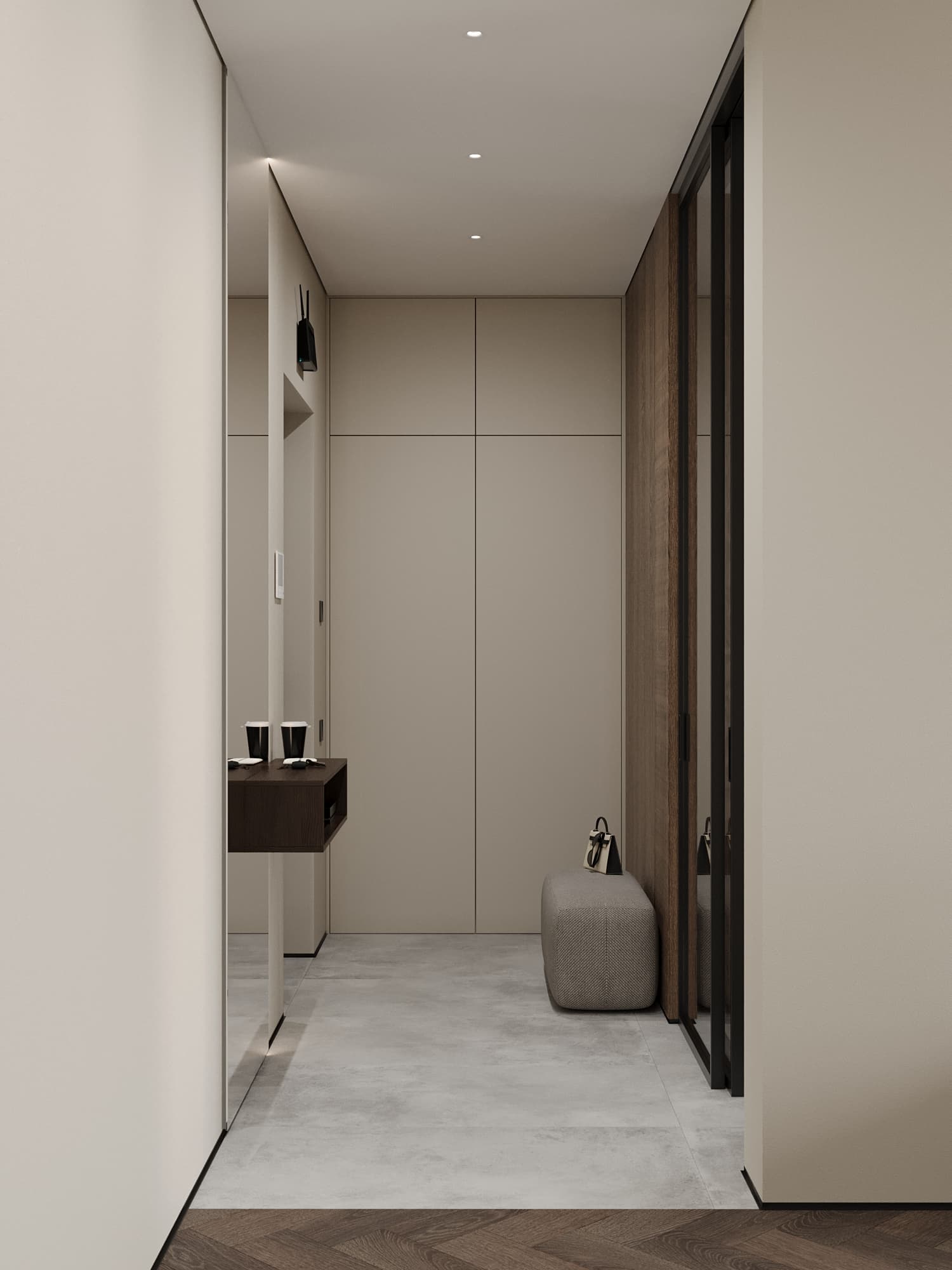
A mirror works in an interior on three levels: practice (looking at yourself), light (a reflected window is almost a second window) and space (visual doubling). One object can widen a narrow hallway, bring light to a dark room and become the central accent of a living room.
Below we cover where to hang a mirror, which formats and frames to choose, how to work with lighting, where mirrors are essential, where they are risky and which mistakes are most common. At the end there is a short checklist.
What a mirror does to space and light
A mirror does not create light but returns it to the room. Daylight reflected from a mirror reaches zones it does not reach directly. That is why a mirror in a dark room works almost like a second window, and in the evening it doubles the effect of lamps and candles. The bigger the mirror and the closer to the light source, the stronger the effect.
A mirror widens space through the illusion of depth: the reflection reads as a continuation of the room. It works better when something interesting is reflected: a window, a beautiful wall, a lamp, a plant. If a blank wall is reflected, the effect is weaker. A mirror also changes acoustics: it is smooth and hard, so it adds echo, and in a room with a large mirror it is worth providing soft surfaces.
Where to hang
Perpendicular or at an angle to the window: the mirror catches and spreads daylight around the room. Directly opposite the window it does not always work: it reflects the window itself with backlight, so by day you see a bright patch and in the evening black glass. It is better to hang the mirror so that a light wall or a part of the room with a good view is reflected.
The dark end of a corridor: a mirror breaks through the wall and lengthens the perspective. In a narrow hallway a mirror on a side wall visually pushes the space apart. Behind a dining zone or console, a mirror panel doubles the light of candles and chandelier, an old trick of formal dining rooms. Above a fireplace, chest or console a mirror becomes the center of the composition.
In a bedroom it is better to place the mirror beside the bed or on a wardrobe door so a lying person is not reflected directly. Many people dislike seeing themselves in a mirror right before sleep, and some do not like mirrors facing the bed because of the sense of an extra observer. It is a matter of personal comfort, not a rule, but better discussed in advance.
Full-height mirror: size and place
A full-height mirror is the mandatory minimum of a hallway and dressing room. Roughly, a glass at least 40 cm wide and 150 cm tall works, and the larger the more convenient: in a big mirror you see yourself whole and from a distance. The lower edge is easier to set at the floor or no higher than 30 cm from it, so you can see your shoes.
Free space in front of the mirror matters: you need distance to step back and see the whole look. At least 1–1.5 m in front makes it convenient. In a narrow hallway the mirror can go on a side wall rather than the end wall. A mirror on a wardrobe door or built into the storage system works well: it takes no separate space.
Lighting near the mirror matters too. Light should fall from the front, on you, not from above or behind: side or frontal light without harsh shadows. For a dressing room and bathroom, vertical lights on both sides of the mirror or contour backlight are better.
Formats and frames
A large frameless mirror set flush to the wall is the most architectural option: it works like an opening. It looks good in minimalism and modern interiors. A mirror in an expressive frame is an art object and part of the composition: in neoclassic and classic it is a gold or dark frame, in a modern interior thin metal, wood or leather.
Round and arched mirrors soften the straight lines of furniture and add gentleness. They hang well above a console, chest or sink. Mirror panels of several parts can take a whole wall, breaking the reflection and making it less blunt. Tinted mirrors (bronze, graphite) give depth without dental-clinic brightness, but they reflect slightly less light.
A facet (beveled edge) adds a classic note, and a matte or aged silvering creates a vintage effect. They are good for decorative mirrors, but for a full-height hallway mirror choose a clean pane to see yourself without distortion.
Mirrors in bathrooms, kitchens and wet zones
In a bathroom the mirror works constantly, but a damp environment needs moisture-resistant solutions. Choose glass with moisture-resistant coating (silver amalgam, protective backing) and a frame of moisture-resistant material: plastic, stainless steel or aluminum. Without protection the edges of a mirror darken and bloom. Ask the manufacturer if a specific model suits a bathroom.
Size the mirror over a sink by the width of the sink: the mirror should preferably be no narrower than the sink. Lighting should be soft, without glare, and hit the face, not from above. Read more about bathroom ergonomics in our checklist. Mirrors are rarely used in kitchens, but a mirror backsplash or panel visually widens a narrow kitchen; in this case you need tempered or protected material and easy cleaning.
Safety and mounting
A large mirror is heavy and breaks into sharp shards. In children's rooms, walk-through zones and places where impacts are possible (hallway, sports area, nursery) it is advisable to use a mirror with a protective film on the back or safety glass. A protective film keeps shards from flying on impact. Ask the manufacturer whether such protection is available.
Mounting must suit the weight. Heavy mirrors need reliable fixings into the base: anchors on slab or concrete, a reinforced backing plate or profile fixing on plasterboard. Do not hang a heavy mirror on an ordinary plug in plasterboard. Floor-standing mirrors are better additionally fixed to the wall so they do not fall, especially if there are children or pets.
Plan the place in advance: it is easier to decide before finishing so reinforcement under the mounting can be built in, and a power cable for lighting laid. This is decided at the stage of the electrical plan and wall elevations.
Common mistakes
A mirror ceiling (greetings from the 90s) and solid mirror walls without composition. A mirror opposite the front door, reflecting the hallway's mess. Small mirror tiles as a mosaic. A mirror reflecting chaos: it doubles the mess too, so hang it where the reflection is worth it. A mirror opposite a window without considering backlight. A kitchen mirror without splash protection. A mirror above or opposite the bed without discussing with the owners. A hallway mirror too small to show the whole look.
Checklist
You know what will be reflected in the mirror. The mirror works for light: it sits perpendicular to or beside the window. There is a full-height mirror in the hallway or dressing room and room to step back. Light falls on the face, not from above. A moisture-resistant glass and frame are chosen for the bathroom. Protective film or safety glass is used in walk-through and children's zones. Mounting is rated for the weight and reinforced at the base. The frame suits the style of the room.
Summary
A mirror is one of the most accessible ways to add light and depth to a room, but only when thought through: place, size, frame, light and safety. We place mirrors on wall elevations and in the lighting plan so they work for the space. Fill in the project brief or message us on WhatsApp, and we will suggest how to use mirrors in your apartment.