June 5, 2026
Kitchen Worktops: Quartz, Acrylic, Compact or Laminate — the Big Comparison
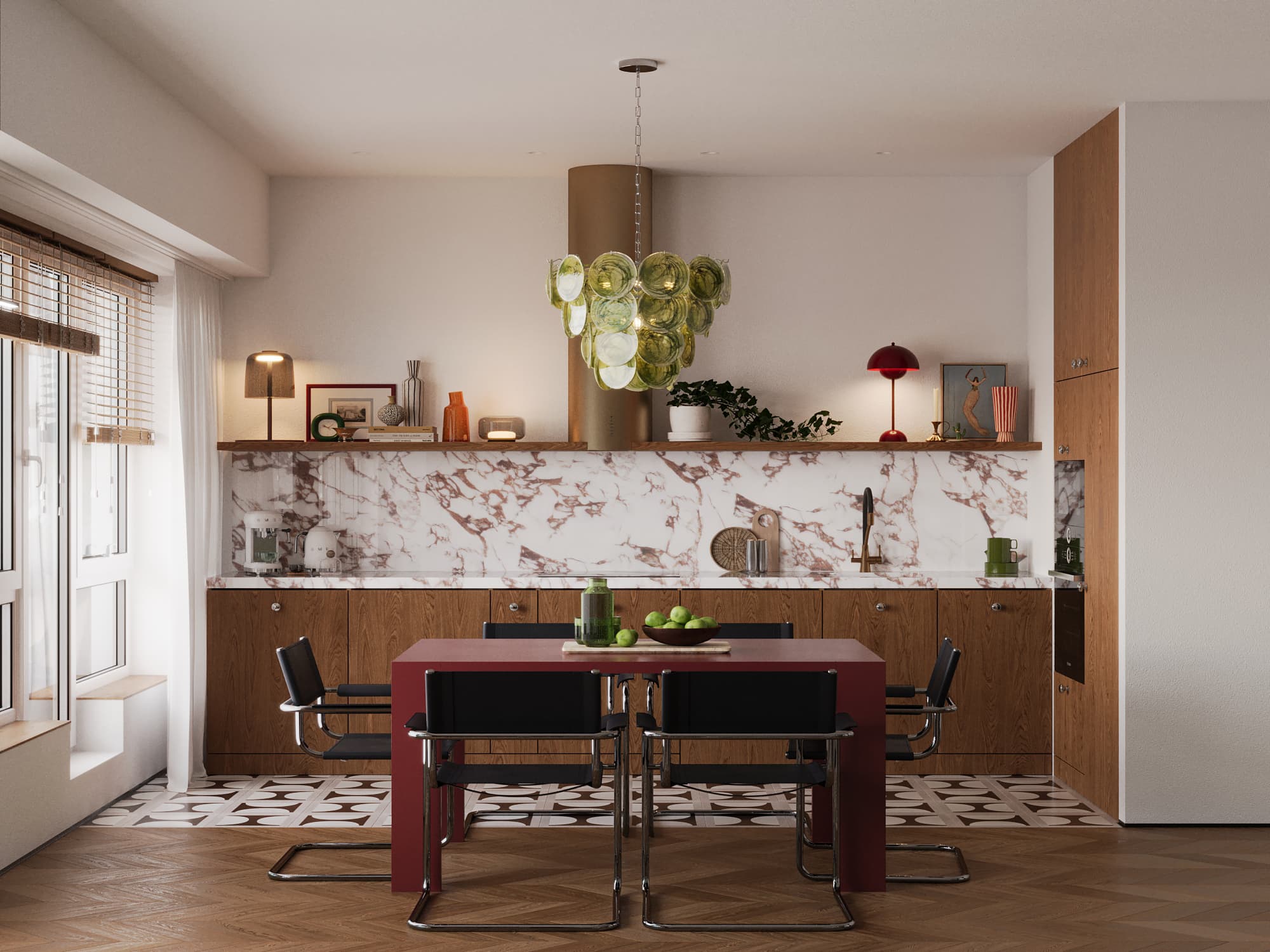
The worktop is the most heavily used surface in the kitchen: hot pans are put on it, food is cut, wine and beetroot juice are spilled. The material is chosen for many years and is hard to change separately from the kitchen, because the worktop is tied to the sink, hob and backsplash. So choose before ordering the kitchen, not after.
We compare the real options on the market, brand-free. Prices in tenge depend on the manufacturer, thickness and complexity of work, so we give relative guidance, and you will get an exact quote from the fabricator against drawings.
Laminate board: the budget standard
A wood-based board with a plastic surface, the most affordable option. Modern decors imitate stone and wood well, and with careful installation the worktop looks decent. The weak points are joints and the sink cutout: if moisture reaches the edge of the board it swells. So edges and cutouts for the sink and hob must be sealed, and the edge banding should be PVC rather than melamine: it is thicker and takes impact better.
For a kitchen choose moisture-resistant board and read the manufacturer’s marking. Laminate fears hot pans, so trivets are a must, and scratches on the plastic cannot be removed. The lifespan depends on care and sealing quality and is usually shorter than stone. It is a good choice for a rental flat or a budget renovation where the kitchen will be replaced sooner.
Quartz agglomerate: the workhorse
An engineered stone made of natural quartz (roughly 90–95% of the composition) with resin and pigments. It does not fear the knife, resists stains and when polished looks like stone. Quartz is the most common choice when you need a durable light or dark surface without seams over a long run.
Downsides: it is heavy, so it needs solid support and careful installation, and the edges are usually simple, as a complex profile costs more. The polymer resin does not like direct contact with a scorching pan, so do not put a pot from the hob straight onto quartz; use trivets. Manufacturers generally state permitted conditions in the instructions, and it is worth reading them before buying.
Acrylic stone: seamless shapes
Acrylic stone is a thermoplastic material: it can be heated and formed into almost any shape, so it is used for seamless worktops with an integrated sink, radius corners and complex islands. The main advantage is repairability: scratches and stains can be sanded out, and joints between sheets become almost invisible.
The price of these abilities is sensitivity. Acrylic softens with heat, so hot pans are unacceptable, and a knife will cut it. Use it only with boards and trivets. It is less resistant to damage than quartz but wins where shape and seamlessness matter. For a kitchen where a lot is cooked on high heat, we would not choose it.
Compact board (HPL): a thin modern profile
Compact laminate is a multilayer material made of papers impregnated with thermosetting resins and pressed under pressure. For worktops 12 mm sheets are used, so the profile is thin and graphic, which works well in minimalism. The material barely absorbs moisture, resists chemicals and is highly wear-resistant, and manufacturers claim good heat resistance too — check the figure in the documentation.
What to consider: a thin board needs a rigid base and proper supports along its length. The edge of compact board is usually coloured through the whole board rather than matching the decor, which is also solved by selection. Joints between boards are visible, so their positions are set in the drawings. We mention this material as an option for modern interiors, not as a universal choice.
Ceramic and sintered stone
Sintered stone (large-format ceramic) is made of mineral components at high temperature. It is one of the most resistant kitchen materials: it does not fear heat, scratches or stains and does not fade in the sun. Slabs come thin and large, so the worktop and backsplash can be made in one pattern.
Challenges: the material is thin and its edges are prone to chipping, it has to be cut on special equipment, and so the work costs more. You need experienced fabricators: a mistake in cutting or installing cannot be fixed. It is the choice for those who want “forever” and are ready to pay for the work. Check exact thicknesses and permitted loads with the manufacturer.
Comparison: what to choose in your situation
Limited budget or a renovation for a few years: laminate with sealing and PVC edging. A practical surface for many years for a family that cooks daily: quartz or sintered stone. Want a seamless island with an integrated sink: acrylic stone, if you can be careful with heat. Love a modern thin profile: compact board.
If in doubt, compare not the material price but the cost of ownership: how many years it will last, what care and repair cost, how it will cope with your habits. Look at samples live in daylight, drop coffee on them and run a fingernail across: you see more than in a catalogue.
Practical rules
Matte and textured surfaces forgive more than gloss: every drop shows on gloss. Light stone with veining hides crumbs better than plain dark stone: a black matte worktop is beautiful until the first breakfast. The worktop–backsplash joint is closed either with an upstand or a minimal sealed seam, and it is detailed in the kitchen drawings.
For any material, a handy board next to the sink and a trivet next to the hob are the best protection. Plan the work zone so the knife and hot items are not in the same spot. Dimensions, cutouts for the sink and hob and joint positions go into the custom furniture drawings that are part of the design project.
How this fits into a project
The studio’s design project contains custom furniture drawings and an online shopping list in which the worktop material is specified with alternatives. The kitchen in the Arena City Life project (67 m², Almaty) was made from our drawings with no rework, which is exactly why worktop dimensions and joints should be settled on paper.
If you want to choose a material for your kitchen and habits, fill in the brief or message us on WhatsApp. For an overall renovation budget guide there is a calculator on the site.
READ ALSO
Wallpaper in a Modern Interior: an Accent, Not a Background — How to Choose and Where to Hang
Curtains and Textiles: a Guide to the Interior's Final Layer
How to Choose a Sofa: Size, Filling, Fabric — and Why Sitting on It Is Mandatory