July 2, 2026
The Bed and Mattress: How to Choose What You Spend a Third of Your Life On
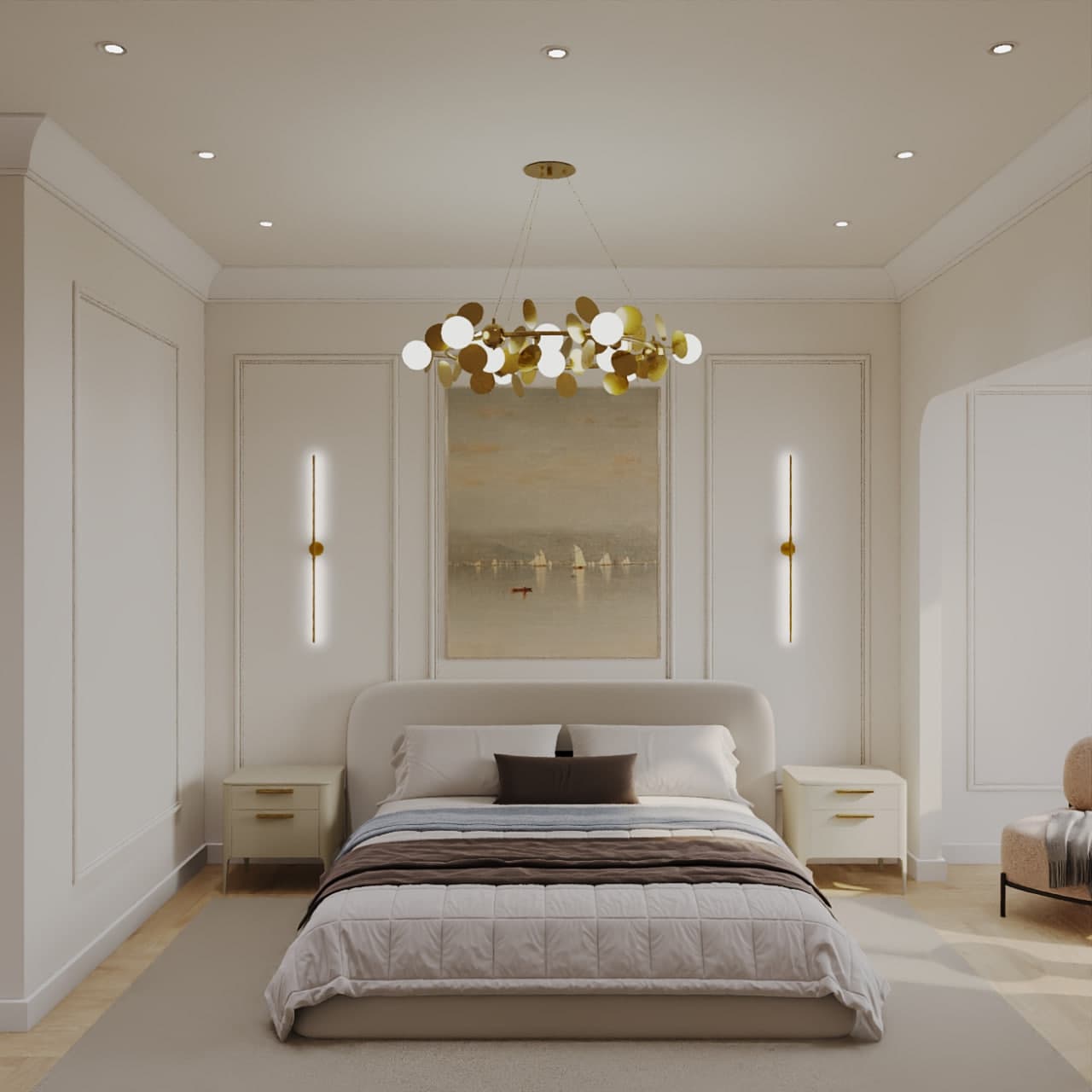
About a third of life passes in bed, yet the mattress often gets "whatever remains" of the budget after the kitchen and sofa. In our projects the logic is reversed: the bed and mattress are a priority line, and it is better to save on decor that is easy to replace. No beautiful headboard or expensive curtains will fix bad sleep.
Below: how to fit the bed size to the bedroom, what clearances to leave, how to choose firmness and mattress type, why the right base matters and what is important in a headboard and storage.
Bed size: from the person and from the room
Standard mattress sizes in Kazakhstan's shops are European: 80 or 90 × 200 cm for one, 140, 160 and 180 × 200 cm for two; 190 and 210 cm lengths also exist. For a couple, 140 cm is the minimum and feels cramped if one person tosses and turns. We recommend 160 cm and up, and if the bedroom allows — 180 cm or two 90 cm mattresses in one bed.
Choose the length with a margin: your feet should not hang over when you lie stretched out with the pillow under your head. Tall people should look for 200–210 cm and a bed without a high footboard, which hits the feet. Remember that the bed itself is bigger than the mattress: the frame and headboard usually add 5 to 20 cm in width and length, and an upholstered headboard even more. This matters in small bedrooms where every centimetre counts.
How much space to leave around the bed
The minimum walkway along the bed and at its foot is about 60 cm; 70–80 cm is comfortable, especially if this is the route to the bathroom or closet. A double bed needs access from both sides: sleeping by the wall and climbing over your partner is awkward, and making such a bed is a pain.
In front of a wardrobe and chest of drawers you need more space: a drawer must open fully and you must stand in front of it. Hinged wardrobe doors need room to swing. So we start a bedroom layout with the bed and clearances, and fit wardrobes and nightstands into the remaining space, not the other way round.
Where to place the bed: headboard against a solid wall, not a window — windows are draughty and give less sense of security. It helps if the door is visible from the bed. A headboard against a wall with the lift or the neighbours' bathroom behind it is a common cause of bad sleep in new buildings; if there is no alternative, consider sound insulation on that wall.
Mattress: how to choose firmness
There is no universally "correct" firmness. A mattress should keep your spine straight in your usual sleeping position. Side sleepers need the shoulder and hip to sink in a little, so soft and medium models usually suit them. Back sleepers need medium firmness: the lower back should neither sag nor hang in the air. Stomach sleepers need a firmer mattress so the pelvis does not dip.
Weight matters too: a light person will find a firm mattress like a board, a heavy one will quickly compress a soft one. If a couple differs a lot in weight or preference, the answer is a mattress with different firmness on each half, or two separate mattresses in one frame with a joining topper.
The main test is to lie in the shop in your sleeping position for 10–15 minutes, ideally with your own pillow. Sitting on the edge and pressing with your hand is not a test. Ask about a trial period and exchange: many manufacturers offer one, and that is a good sign.
Springs or foam: mattress types
A pocket-spring mattress has each spring in its own sleeve, so a partner's movements barely transfer and the mattress breathes well. The more springs per square metre, the more precisely it follows the body. Mattresses with an interconnected (bonnell) unit are cheaper but move as one piece and are less suitable for everyday sleep.
Springless mattresses made of foams — orthopaedic foam, memory foam, latex — hug the body closely and do not creak. Natural latex is resilient and durable but more expensive. Memory foam relieves pressure well but holds heat — worth considering in Almaty's hot summer. Hybrid models combine a spring unit with foam layers.
Between a good spring and a good springless mattress the choice is about feel, not "which is better". Material quality and foam density matter more. A mattress's lifespan is usually put at 7–10 years; if dips, lumps appear or you wake up with back pain, it is time to replace it, even if the term is not up.
The base: what people forget
A good mattress on a bad base performs badly. The best option for most mattresses is an orthopaedic base of curved wooden slats: it flexes and ventilates the mattress from below. The gap between slats should meet the mattress manufacturer's requirements, otherwise the warranty may not apply. A solid board base is not suitable for every model — without ventilation underneath, a mattress can get damp.
A sleeping surface (top of the mattress) at roughly knee height makes it easy to sit down and get up. This is especially important for older people: a very low platform bed looks striking, but getting up from it is hard.
Headboard and storage
An upholstered headboard is needed if you read or watch films sitting up in bed. A tall headboard, 100–120 cm from the floor or more, becomes part of the room's architecture: it sets the composition, and wall lights and nightstands are aligned to it. In a 93 m² neoclassical apartment in Kamenka Park we designed a bedroom with a classic headboard — it became the room's main accent. Sometimes instead of a bed headboard we draw a full-width wall panel with built-in lighting and sockets.
A lift-up mechanism is a small apartment's best friend: under a 160 × 200 cm mattress with a box about 30 cm deep there is almost a cubic metre of storage — blankets, suitcases, seasonal clothes. The gas lift must match the mattress weight, otherwise the lid will be hard to lift or will drop. If the mattress is heavy or you need something under the bed every day, drawers are more convenient. A bed on legs looks lighter, but dust collects underneath — leave a gap for a vacuum or robot.
Sockets and light by the bed
Bedside wiring is often thought of too late. Each side needs at least two sockets (phone and lamp or humidifier), a switch for the main light so you do not have to get up, and a separate switch for bedside lighting. Wall lights free up the nightstand and give directed reading light. If the bed is not chosen yet, we place sockets for the width of the future bed with a margin — their position is hard to change later.
Common mistakes
A 140 cm bed for a couple in a bedroom that could fit 160. A mattress bought from a photo without lying on it. A beautiful bed with a base that does not suit the mattress. A 40 cm walkway by the wardrobe where the door cannot open fully. A headboard against the window or a noisy wall. A lift-up mechanism that ignores mattress weight. Sockets behind the nightstand that you cannot reach. And skipping a mattress protector: it guards against stains and wear and noticeably extends the mattress's life.
Summary
A good bedroom starts with the right bed size, proper clearances and a mattress that suits your sleeping position and weight. Everything else — headboard, light, storage — helps but does not replace the basics. In a design project we plan the bedroom together with the electrics and lighting for a specific bed, and select furniture in the shopping list. If you want to plan your bedroom, take the "What is your style" quiz, fill in the project brief or message us on WhatsApp.
READ ALSO
Wallpaper in a Modern Interior: an Accent, Not a Background — How to Choose and Where to Hang
Curtains and Textiles: a Guide to the Interior's Final Layer
How to Choose a Sofa: Size, Filling, Fabric — and Why Sitting on It Is Mandatory