September 3, 2026
Wallpaper in a Modern Interior: an Accent, Not a Background — How to Choose and Where to Hang
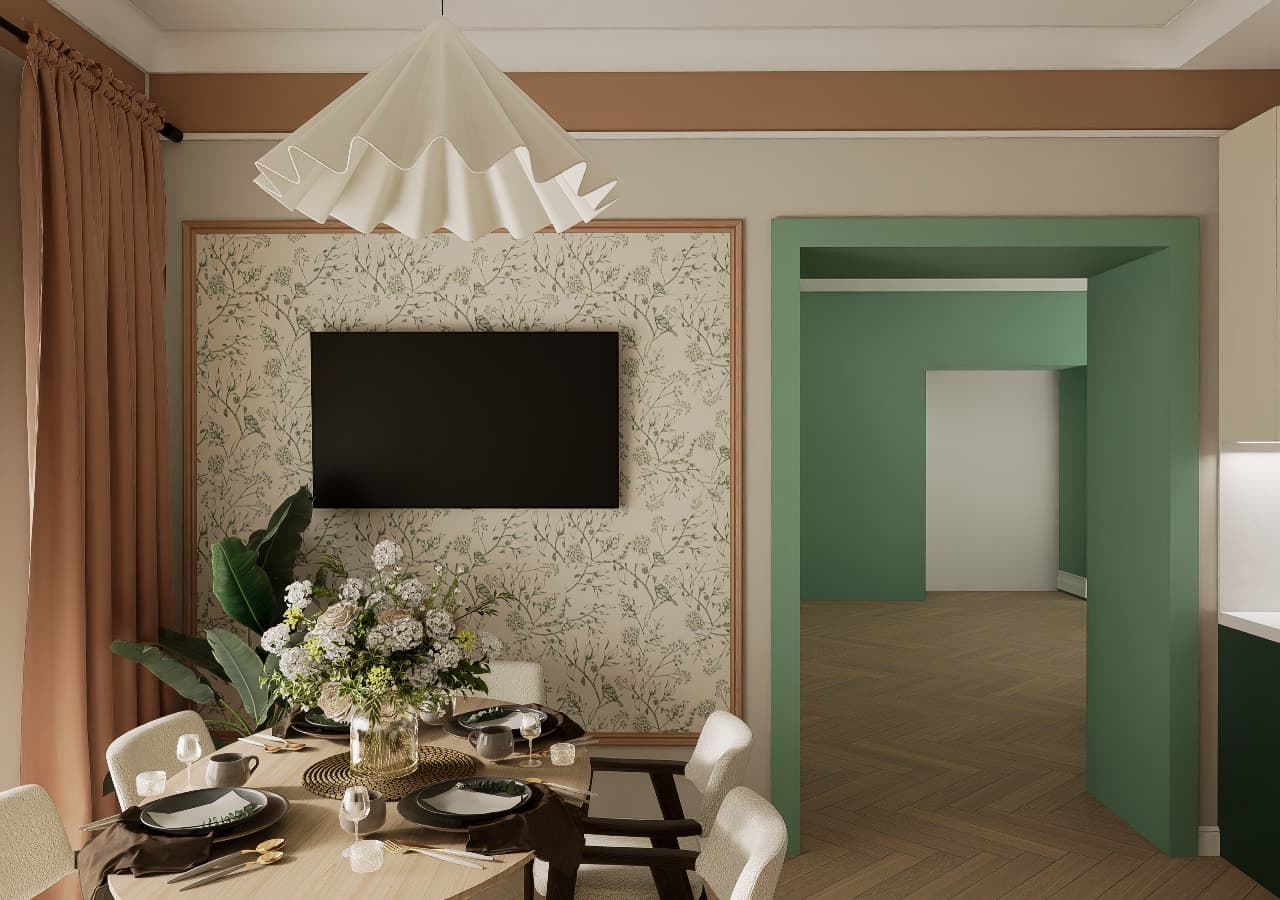
For a long time wallpaper lost out to paint, and now it is back — in a different role. Modern wallpaper is usually not "a background on every wall" but one expressive wall: a large pattern, botanicals, a texture paint cannot give. Wallpaper framed with mouldings works like a painting and suits neoclassical interiors — the style in which we created, for example, a completed 40 m² kitchen-living room in a country house near Astana.
Below: where wallpaper is appropriate and where it is not, how the main types differ, how to read the symbols on the label, how to count rolls with the pattern in mind, how to prepare walls and how to tie wallpaper into the rest of the finishes.
Where wallpaper works best
Rule number one: one wall. The best places are behind the bed, behind the sofa, in the dining area, in the hallway, in a niche or in a moulding frame. There the wall is seen as a whole and the pattern does not hide behind wardrobes. In a child's room wallpaper often goes on one or two walls, leaving the rest painted so it is easier to refresh as the child grows.
The pattern scale is chosen for the room and furniture. Large botanicals or a mural open up on a free wall where they can be seen from a distance. A small pattern tolerates furniture in front of it and suits small rooms. Vertical stripes visually raise the ceiling, horizontal ones widen the wall. In a small room, dark patterned wallpaper does not necessarily "eat" space — on one wall it creates depth.
Textured plain wallpapers — imitating linen, burlap, plaster — are a compromise for those who find paint boring and patterns too bold. They give depth under side light and hide small irregularities that paint would only emphasise.
Where not to hang wallpaper
The area by the hob and sink: splashes, grease and steam. Tiles, glass or washable paint are better there. The bathroom beyond dry zones: by the shower and bath, tiles and moisture-resistant finishes win. Walls that are constantly brushed against — a narrow corridor, the corner by the front door, the wall behind dining chairs: wallpaper wears out quickly there, so choose scrubbable types or protect the lower part with a wall panel. And cold external walls at risk of condensation: dense vinyl on such a wall can encourage mould under the sheet.
Types of wallpaper: what to choose
Paper wallpaper is the simplest and most "breathable", but thin, tears during hanging, does not tolerate wet cleaning well and highlights uneven walls. Today it is chosen mostly for a particular pattern.
Non-woven wallpaper is now the standard. The non-woven base barely stretches or shrinks as it dries, so strips are butted together; paste is usually applied to the wall rather than the sheet, which speeds up the work. At the next renovation it can usually be stripped dry in whole strips. Paintable versions can be repainted several times.
Vinyl wallpaper on a non-woven or paper base has a film top layer. It is durable and washable, suits the hallway and kitchen areas away from the hob, but lets less vapour through. Textile wallpapers (with a linen, silk or cotton top layer) are beautiful and expensive, need careful hanging and gentle care; they are chosen for bedrooms and living rooms. Glass-fibre wallcovering is a paintable base, very strong and good at reinforcing the wall; it is often used in commercial interiors and corridors.
How to read the label
A roll label carries symbols many people skip. Their meanings are defined by the European standard EN 235. One wave: the wallpaper can only be lightly wiped with a damp sponge. Two waves: washable — light dirt is removed with a damp sponge without chemicals. A wave with a brush: scrubbable — it can be cleaned with a soft brush and mild detergent; suitable for kitchens and hallways.
Also look at: the paste symbol (paste the wall or the paper), the pattern match (free match, straight or offset), the repeat size in centimetres, how it is removed at the next renovation, and lightfastness — how much it fades in the sun. And the batch number: all rolls for one wall should come from one batch, otherwise the shade may differ.
How many rolls: counting by the repeat
Rolls come 53 cm or 106 cm wide and usually about 10 m long. Count by strips, not by wall area. First, how many strips the wall needs: divide the wall width by the roll width and round up. Then, how many strips a roll yields: divide the roll length by the wall height plus allowance for trimming and the repeat, rounding down.
The repeat is the distance after which the pattern repeats. The bigger it is, the more offcuts go into matching neighbouring strips. With a straight match strips align at the same height; with an offset match the pattern shifts by half a repeat, and there is usually more waste. Free-match wallpaper (no matching) is the most economical.
We allow at least one roll above the calculation: for mistakes during hanging and for future repair of a damaged area — buying the same batch a year later is almost impossible. In our finishes schedules wallpaper consumption is calculated per wall, accounting for openings.
Preparing the walls
Wallpaper is not a way to hide a crooked wall. Thin and glossy sheets, as well as dark plain wallpapers, show every bump, especially under side light. A wall for wallpaper is levelled and skimmed, then primed — primer evens out absorption so the paste holds uniformly. If the wallpaper is light and thin and the wall is patchy in colour, even out the tone first, or stains may show through.
Sockets and switches on a wallpapered wall should be planned in advance: plates in the middle of a large pattern look accidental. For heavy sheets and where shelves or a TV will go, it is better to know in advance where the fixings will be, so the finished surface does not have to be cut.
How to tie wallpaper into the rest of the finishes
Wallpaper should not look like a sticker. A simple trick: repeat one colour of the pattern, usually the background, in the paint of the neighbouring walls or in textiles — then the accent grows into the room. The joint between wallpaper and paint is best placed in an inside corner or hidden under a moulding: on a flat plane the edge almost always looks untidy.
Mouldings are a classic: framed wallpaper on a living room wall or above panelling in a dining room. Such a composition requires precise setting out, so we draw the moulding layout on wall elevations. Another trick is wallpaper above a wall panel or paint on the lower third of the wall: the bottom is protected from scuffs, and the pattern stays at eye level.
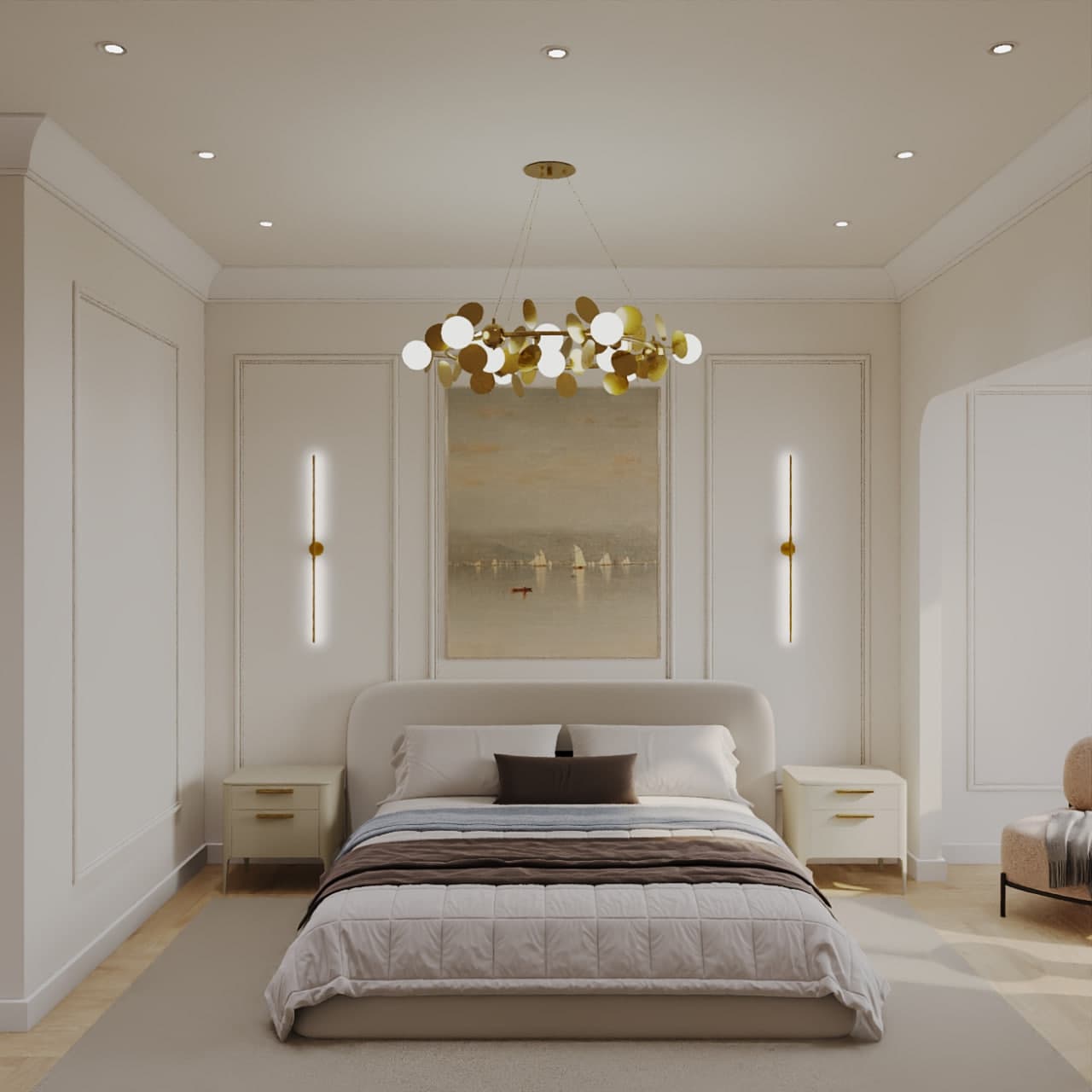
And light. Pattern and texture come alive under side and directed light: wall lights either side of the bed, a wall-washing light from above or sconces turn the wallpapered wall into the room's main stage. Flat overhead light, on the contrary, kills texture.
Common mistakes
A large pattern on every wall of a small room. Rolls from different batches. Buying "just enough" with no allowance for the repeat. Wallpaper by the hob or next to the shower. Hanging on an unprepared wall. Dark wallpaper without considering that the light base may show at the joints: edges are sometimes tinted. A wallpaper-to-paint border in the middle of a plane. And a socket in the centre of a mural.
Summary
Modern wallpaper is a tool for one precise wall, not a background throughout the apartment. Choose the type for the room, read the label symbols, count rolls by the repeat with a margin and prepare the wall as you would for paint. In our working drawings we specify where and which wallpaper goes in the finishes schedule and on wall elevations. If you want to choose wallpaper for your interior, look at our Style Guide, fill in the project brief or message us on WhatsApp.
READ ALSO
Curtains and Textiles: a Guide to the Interior's Final Layer
How to Choose a Sofa: Size, Filling, Fabric — and Why Sitting on It Is Mandatory
The Bed and Mattress: How to Choose What You Spend a Third of Your Life On