April 29, 2026
Custom or Ready-Made Furniture: What, Where and Why
In every project with procurement we split furniture into two streams: what is made from our drawings and what is bought ready-made. The split is not random. Each stream has its own economics, lead times and strengths. The general rule is simple: everything built-in is custom, everything freestanding is ready-made.
Below we explain why the rule works, where the exceptions are, what cabinet furniture is made of, how to avoid mistakes with a joinery workshop and why 80% of custom furniture quality depends on the drawings, not the workshop.
What we have made to order
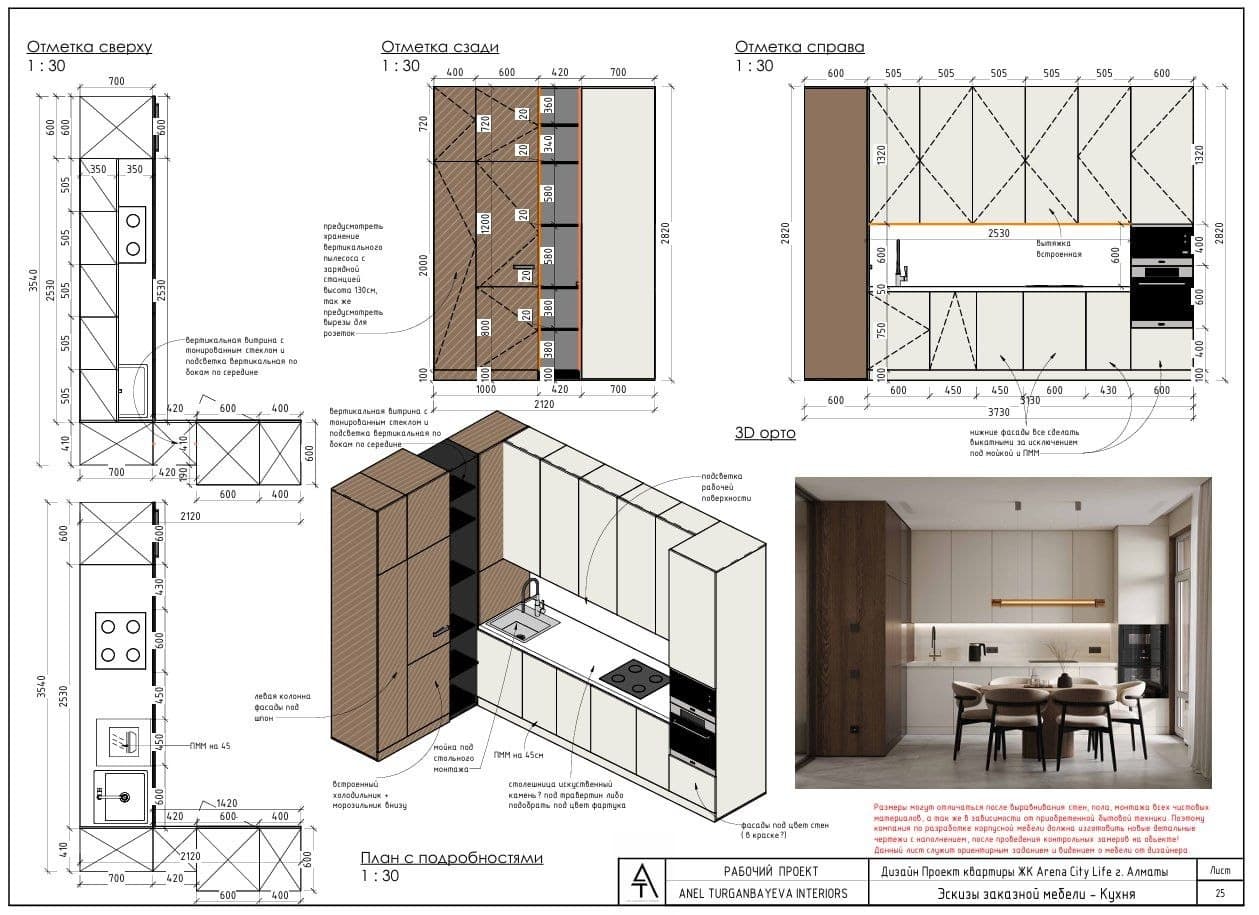
The kitchen, almost always. It is tied to the services, ventilation, sockets and wall geometry of a specific apartment. A modular store kitchen is assembled from standard-width cabinets, and a real room is left with gaps covered by filler strips. A custom kitchen runs wall to wall and up to the ceiling, with appliances, sink and hood exactly where the services come out.
Built-in wardrobes and walk-in closets. A factory modular system leaves gaps at the walls and ceiling and rarely includes a top tier up to the ceiling. Invisible handleless fronts painted in the wall colour, on push openers, are possible only with custom drawings. In a 67 m² apartment in Arena City Life we did exactly these invisible wardrobes, and the mid-size space became noticeably calmer.
Furniture for non-standard niches: window-sill desks, bay-window benches, shelving around a doorway, bathroom vanities for a specific basin, desks in a niche. Also furniture that solves an engineering task: in our Taldykorgan project, a floor-to-ceiling wardrobe with slatted fronts, ventilation milling and a top storage tier.
What we buy ready-made
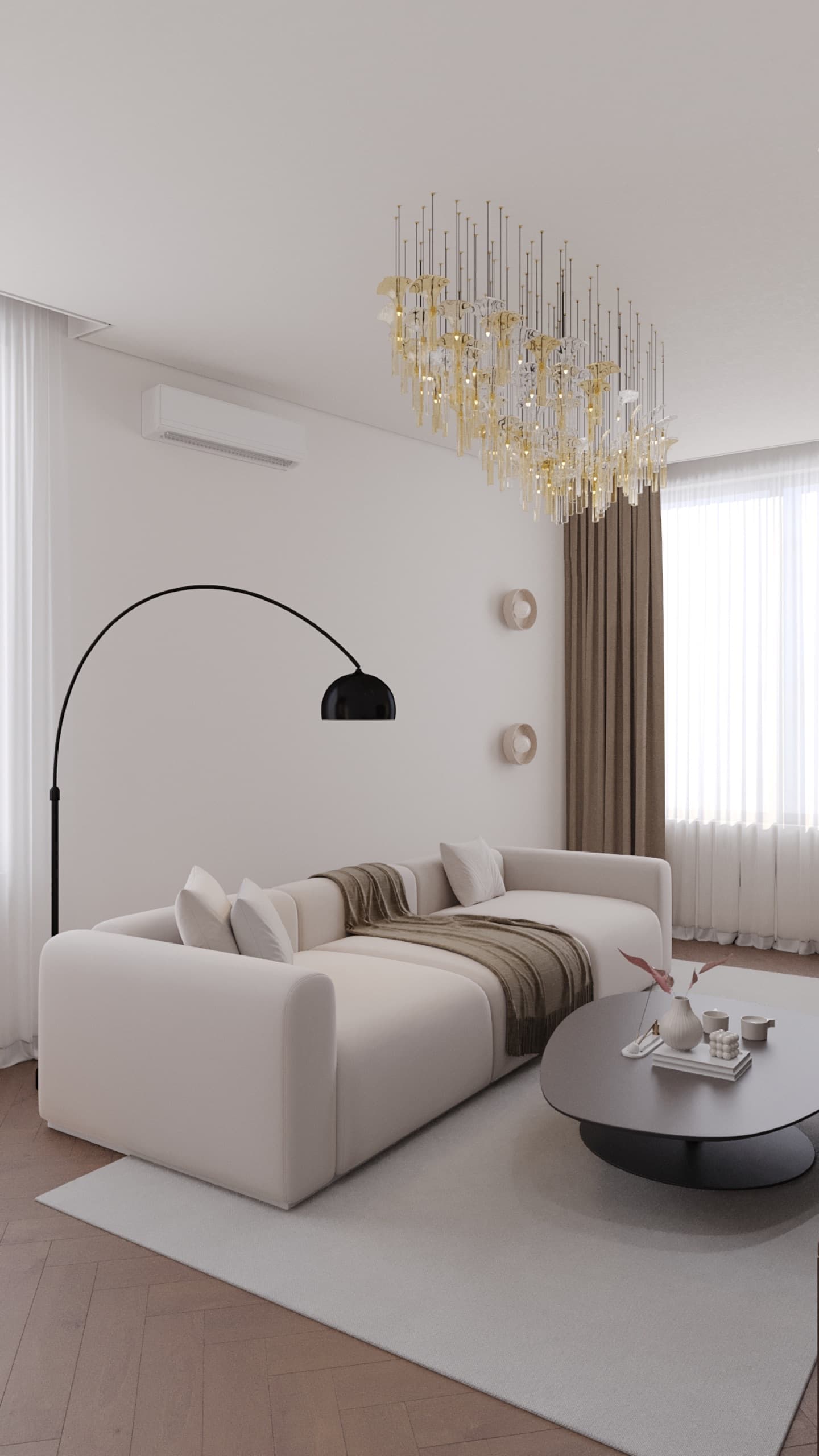
Sofas and armchairs. Factories have proven mechanisms, frames, fillings and fabrics with clear specifications, whereas custom upholstery from small workshops is a lottery: you cannot test the seat before it is made. A sofa you sat on for ten minutes is safer than one ordered from a sketch.
Tables, chairs, beds. The market is huge, and designer pieces set an interior's character: a chair with a recognisable shape, a solid wood dining table, a bed with an upholstered headboard. You can have them made, but matching series-production quality in a workshop is hard and usually no cheaper.
Lighting and decor, ready-made only. Light fittings need certificates and clear specs: luminous flux, colour temperature, IP rating. Decor, textiles, rugs and framed mirrors also come from stores: they are easy to replace when you want to refresh the interior.
Exceptions to the rule
Ready-made built-in systems sometimes win. If a walk-in closet is simple, without fronts and behind a door, a metal or modular storage system is cheaper and faster, and its interior is easy to rearrange. In a child's room, where everything will change in a few years, modular furniture is sensible too.
Custom freestanding furniture can also make sense: a dining table of non-standard length for a particular niche, a coffee table in the same stone as the kitchen worktop, a headboard spanning the whole bedroom wall. Here custom gives you what is not for sale, a conscious choice rather than a saving.
What cabinet furniture is made of
Melamine-faced chipboard is the most common and affordable material for wardrobe and kitchen carcasses. A key parameter is the formaldehyde emission class. For homes choose E1 or better: under the European EN 717-1 test method, class E1 means a chamber formaldehyde concentration below 0.1 ppm. Ask the workshop for the board certificate.
MDF is a board of fine fibres. It is denser and more uniform than chipboard and mills well, so it is used for painted lacquer fronts, milled, fluted and curved elements. Lacquer can be matt or gloss: matt hides fingerprints better, gloss shows unevenness more.
Veneer is a thin slice of natural wood on an MDF base. It gives a living wood texture and looks more expensive but needs careful use. Solid wood is for worktops, tables and individual elements. For fronts in bathrooms and near the sink moisture resistance matters: edging must be tightly glued on all sides and cut ends protected.
Dimensions worth knowing
A wardrobe for clothes on hangers needs a depth of about 60 cm, the minimum for comfortable storage. Sliding doors take another 8–10 cm of depth for their track, so such wardrobes are made deeper or clothes hang slightly at an angle. A hinged wardrobe without a rail can be shallower, about 55 cm.
Internal heights depend on your clothes: long dresses and coats need more height than shirts and trousers. So before ordering we ask clients to measure their longest garments and count how many shelves, drawers and rails they need. Kitchen dimensions, worktop height, distance to wall cabinets and depth, are covered in our kitchen ergonomics checklist.
How to order furniture without rework
Drawings are everything. A joiner needs not a picture or a napkin sketch but elevations of every piece with dimensions, materials, hardware, appliance positions and details. Then the workshop quotes accurately and the piece is assembled without on-site fixes. Joiners built the Arena City Life kitchen from our drawings without a single redo, and for a 115 m² apartment in Bukhar Zhyrau Towers we prepared seven sheets of custom furniture drawings: a kitchen with built-in appliances, wardrobes and the bathroom.
The sequence: rough works, plaster and screed first, then the joiner's check measurement on finished walls, not on the drawings. Next, the workshop's drawings are approved by the designer, a contract specifies materials, hardware and deadlines, then manufacturing and installation. Lead times depend on the workshop and its workload, so order the kitchen early so it does not delay your move.
Compare quotes from different workshops on one specification. If one quote has branded hardware and another unnamed fittings, the price gap makes sense. In the contract record the board brand, front type, hinge and runner manufacturer and the warranty period.
Economics: which costs more
Custom furniture is usually more expensive than the mass market but cheaper than designer brands when it fits the space exactly. A custom wardrobe uses every centimetre up to the ceiling, while a ready-made one leaves empty zones. A custom kitchen costs more than a modular one but lasts longer and needs no fillers or compromises.
Ready-made furniture wins on lead time and predictability: you see and touch it before buying, and delivery takes days or weeks. In design project schedules we list specific ready-made items with alternatives at two or three price levels, and custom furniture with diagrams and drawings. Where to save is your choice.
Conclusion
Built-in is custom, freestanding is ready-made, with conscious exceptions. Custom furniture is exactly as good as its drawings and measurements. Custom furniture diagrams are part of our design project together with online procurement of ready-made items; drawing examples are in the Custom Furniture Drawings section and the portfolio. To discuss your kitchen or wardrobe, fill in the brief or message us on WhatsApp.
READ ALSO
Wallpaper in a Modern Interior: an Accent, Not a Background — How to Choose and Where to Hang
Curtains and Textiles: a Guide to the Interior's Final Layer
How to Choose a Sofa: Size, Filling, Fabric — and Why Sitting on It Is Mandatory