March 26, 2026
Bedroom Design: How to Plan a Room Where You Actually Sleep Well
A bedroom has one key metric: how well you sleep in it. Beauty here has to serve sleep, otherwise you get a hotel room with poor rest. A good bedroom means the right geometry, light that does not wake you, darkness, coolness, quiet and a calm palette.
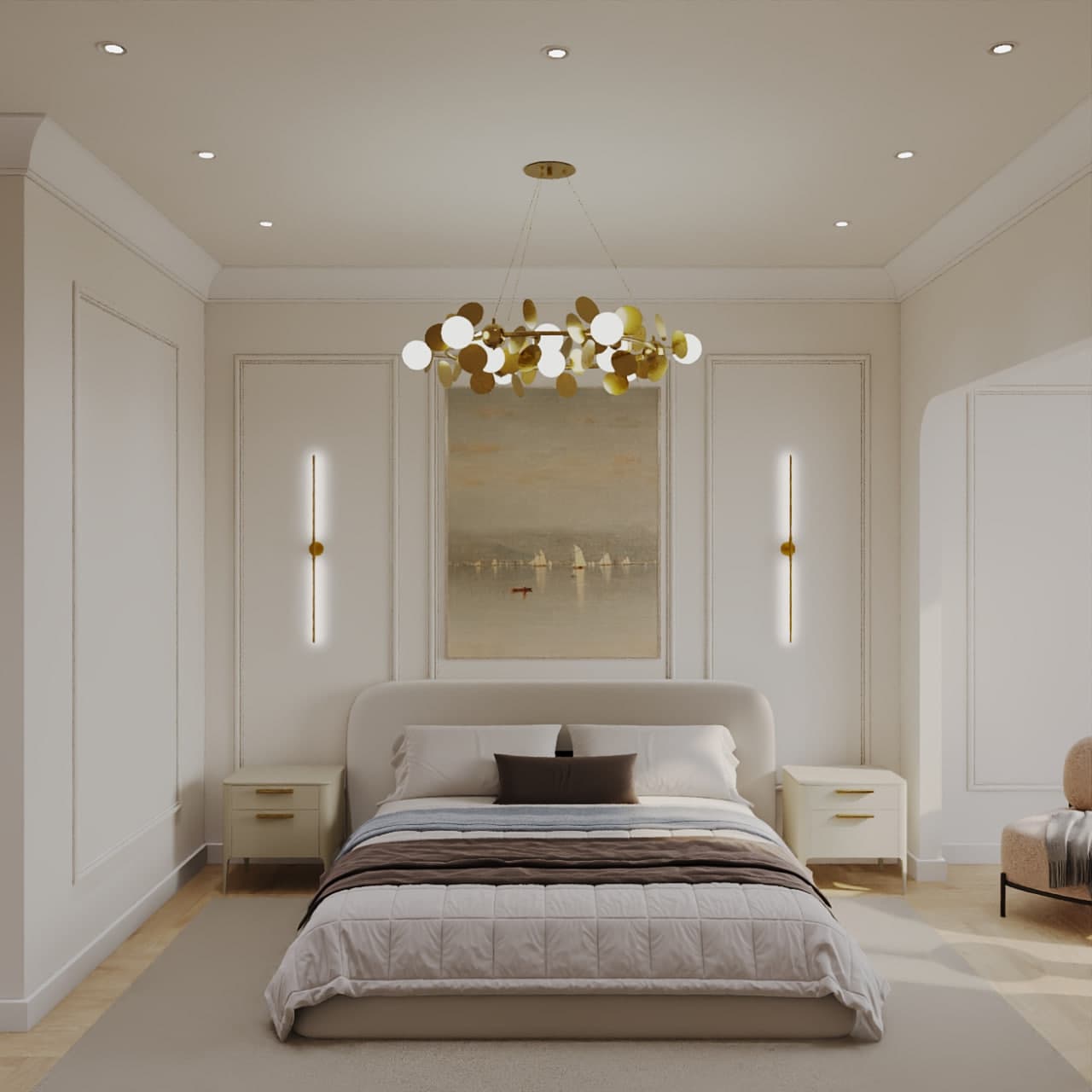
In this article we have collected the rules we use to design bedrooms: bed sizes and clearances, where to place the headboard, how to organise storage, lighting and curtains, what temperature and air you need for sleep, and which mistakes to avoid. Our example is the bedroom in our 93 m² project in Kamenka Park, Almaty: neoclassical, with mouldings, a symmetrical composition, a soft palette and a classic headboard.
Bed and clearances: bedroom geometry
Standard double bed widths are 140, 160 and 180 cm. For two people 160 cm or wider is more comfortable: 140 cm is tight for a couple, especially if one of you sleeps restlessly. Choose a mattress length with some margin over your height: usually 200 cm.
The bed needs clearances. A common ergonomic recommendation is at least 60–70 cm on each side, so you can walk up, lie down and make the bed comfortably. Making a bed in a 40 cm gap is a daily irritation. In front of a hinged wardrobe, allow for the width of the open door and the space where you stand to choose clothes: a wardrobe that cannot open fully because of the bed is a common mistake.
That is why we always start with a dimensioned furniture plan, not with choosing a bed in a shop. First we check what width actually fits with clearances, and only then pick the model.
Where to place the bed
The headboard is best placed against a solid wall. A headboard under the window means draughts, cold glass in winter and light in your eyes in the morning. A headboard in a passage or with your back to the door feels exposed: many people feel calmer when they can see the door from bed.
If there is a radiator in the bedroom, do not push the bed against it: the heat will dry the air around your face, and the radiator will heat the room less well. Think about sockets too: each side of the bed needs at least one socket for a phone and a light switch, and their height is best planned around the bedside table and headboard.
Storage: wardrobe or walk-in closet
If space allows, a separate walk-in closet unloads the bedroom: only the bed, bedside tables and perhaps a chest of drawers stay in the room. Fewer things, less dust and visual noise, and you can get dressed without switching on the light where your partner sleeps.
Without a walk-in closet, the best option is a built-in floor-to-ceiling wardrobe along one wall. The standard depth of a wardrobe for clothes on hangers is about 60 cm. Fronts in the wall colour make the wardrobe almost invisible, and sliding doors save space where there is not enough clearance for hinged ones. Under-bed storage — a lift-up base or drawers — is handy for seasonal bedding and duvets.
Lighting: several scenes and no lamp in your eyes
The main rule: lying in bed, you should not see any bright light source directly. A pendant right above your face or spotlights over the pillow are common mistakes. Bedroom lighting is built in scenes: soft general light for cleaning and getting ready, local light by the bed for reading, dim evening light and a night light to reach the bathroom without switching everything on.
Be sure to put switches by the bed — on each side if two people sleep there — and make them two-way with the switch by the door. Then you do not have to get up to turn off the light. A dimmer on the general light pays off every evening.
Why this matters for sleep. A study published in the Journal of Clinical Endocrinology and Metabolism showed that ordinary room light before bedtime delays the production of melatonin, the hormone that regulates sleep, and that light during sleeping hours suppresses it. So in the evening it is better to switch to warm, dim light, and at night to full darkness.
Curtains and darkness
In a city it is never truly dark outside: street lights, signs, headlights, neighbouring buildings. So blackout curtains or heavy lined curtains in the bedroom are not a whim but a condition for normal sleep. In summer it gets light early in Kazakhstan, and without blackout many people wake up at five in the morning.
For blackout to work, light must not leak around the edges. The curtain track is best run wall to wall and hidden in a ceiling recess, with curtains down to the floor. A double track is a good option: sheers by day and blackout at night. If the window faces a noisy street, heavy curtains also help a little with noise.
Temperature and fresh air
A cool bedroom is better for sleep. The US-based Sleep Foundation names about 18 °C as optimal, allowing a few degrees of variation from person to person. Apartments with central heating are often much warmer in winter, so it helps to fit thermostatic valves on radiators and not put underfloor heating under the bed.
The second factor is fresh air. In winter in Almaty and Astana you often cannot leave the window open all night because of frost or smog, and a closed bedroom becomes stuffy overnight. The solution is supply ventilation: a compact air purifier-ventilator (breezer) or a supply vent. Its position, socket and wall opening should be planned in the project before the renovation.
Quiet
Soft surfaces absorb sound in a bedroom: an upholstered headboard, a rug, heavy curtains, textiles. In an empty room with bare walls and laminate, every sound bounces and grows louder. A proper interior door with a seal noticeably separates the bedroom from the living room and kitchen.
If the bedroom wall borders a neighbour's lift or living room, it can be soundproofed during the rough works. It costs money and takes a few centimetres of floor area, so the decision is best made at the layout stage.
Palette and materials
Muted, complex shades work in a bedroom: warm neutrals, soft beiges and greys, dusty greens and blues. Bright contrasts and busy prints are better left for the living room: the bedroom is the one room where a little 'boring' is right. Matte surfaces are calmer than gloss: they do not reflect the lights.
Materials should be pleasant to touch: wood, linen, cotton, wool. In the Kamenka Park bedroom we worked in neoclassical style: mouldings on smooth walls, a symmetrical composition around the bed, a soft palette and a classic headboard. Such an interior looks calm and does not get tiresome over the years.
Typical bedroom mistakes
The bed was chosen before the furniture plan, leaving 40 cm clearances. A pendant or spotlights right above the pillow. A switch only by the door. No sockets by the bed, so chargers run across the room. Thin curtains that let the street light through. A bed by the window or radiator. A TV and desk that turn the bedroom into an office. No fresh air supply, so the room is stuffy in the morning.
All these mistakes are easier to prevent at the project stage than to fix after the renovation: switches and sockets, the curtain recess and the breezer position are all set during the rough works.
Conclusion
A good bedroom is not the most expensive bed but well-planned clearances, lighting scenes, darkness, coolness, quiet and a calm palette. If you want a bedroom designed for your sleep rather than for someone else's photos, fill in the project brief — we ask about how you sleep there too. Or message us on WhatsApp.