June 11, 2026
Project Procurement: How Drawings Turn Into Materials and Furniture
Procurement is a stage few people think about before renovation starts. The project is approved, and it turns out hundreds of items must be found, ordered, paid for, received and timed: from tiles and plumbing to door handles and sockets. Some items come from stock in a couple of days, others take weeks or months. A mistake in sequence stops the works and leaves the crew idle.
This article covers what procurement consists of, what order to buy in, how to calculate quantities and allowances, what to check on delivery and which mistakes are most common. At the end: what we do and what stays with you.
What procurement is
Procurement translates a project into specific purchases. The drawings say "porcelain tile 60×120, light beige, matt, 18 m²"; procurement answers which exact item code, from which supplier, at what price, how many days to wait, how many boxes to take with allowance and when they must arrive on site.
Its basis is the project schedules: wall finishes, floor plan, plumbing plan, lighting plan, furniture specification. The more detailed the project, the fewer questions at this stage. Without a project, procurement turns into endless shop visits and on-the-spot decisions that later do not fit together.
The shopping list: what it should contain
Our design project includes online procurement in the form of a shopping list. It is a table that lists every item room by room: finishes, plumbing, lighting, furniture, decor. For each: name, item code or link, quantity, dimensions, colour and approximate price.
A good shopping list lets you calculate the budget before renovation and compare it with the plan. If the total is higher, you can swap expensive items for alternatives in advance rather than discover an overspend mid-build. As a guide: renovation with materials in Almaty and Astana in 2026 usually costs from about 150,000 ₸ per m² for economy, about 250,000 ₸ for comfort and from about 450,000 ₸ for premium; furniture and appliances are extra, plus a reserve of about 10%. You can estimate your case in the "Renovation budget calculator".
What order to buy in
The main principle: order first what takes longest to deliver and what the crew needs earliest. Before rough works, decide on WC installation frames, concealed mixers, floor drains and shower channels, and frames for flush doors. They are built into walls and floors at the rough stage, and without them the crew cannot move on.
By the start of finishing works the site should have tiles, grout, adhesive, flooring and paint. Doors are usually ordered in advance and installed after wall finishing. Kitchens and built-in furniture are ordered from precise measurements after plastering, because wall geometry may change. Upholstered furniture, lighting and decor can be ordered in parallel to arrive at the end.
Make a simple schedule: item, lead time, when it is needed on site, order date. It takes an hour and saves weeks of downtime.
How to calculate quantities and allowance
Exact quantities come from the drawings: wall areas from elevations minus openings, floor area from the plan, numbers of lights and sockets from the lighting and electrical plans. Guesswork is costly both ways: a shortage stops work, surplus sits on the balcony for years.
For tiles an allowance of 10–15% for cutting and breakage is usual. For diagonal laying, herringbone and large formats it is higher, up to 15–20%. Buy the whole amount from one batch: different batches of the same tile can differ in shade, and buying "exactly the same" a month later is not always possible. Keep a box or two after the renovation for replacing damaged tiles.
The same applies to wallpaper (one batch and roll number), parquet and laminate, and tinted paint. For paint, note the tint code and base name: touching up a wall a year later will be easier.
Alternatives: when an item is out of stock
Often the chosen item is out of stock or discontinued. Look for an equivalent, not just something "similar". Check not only colour in a photo but format, thickness, texture, wear class, connection sizes for plumbing, colour temperature and wattage for lighting.
If one item changes, check how it fits with its neighbours: another tile format changes layout and cutting, another mixer height changes outlet positions, another oven depth changes the kitchen unit. That is why substitutions are best agreed with the designer who sees the whole project.
Receiving: what to check on delivery
Open the packaging in front of the driver or courier, at least selectively. Check quantity, item code, batch number and shade on the boxes, and integrity. Broken tiles, chipped fronts or the wrong colour should be photographed and noted on the delivery note before signing: after signing it is much harder to prove the damage happened in delivery.
Lay out tiles from different boxes side by side in daylight to see tone differences. Check furniture and doors for chips, scratches and correct dimensions. Store materials on site dry and safe: laminate and parquet are usually acclimatised in the room where they will be laid, for the time the manufacturer specifies.
Custom furniture and orders from China
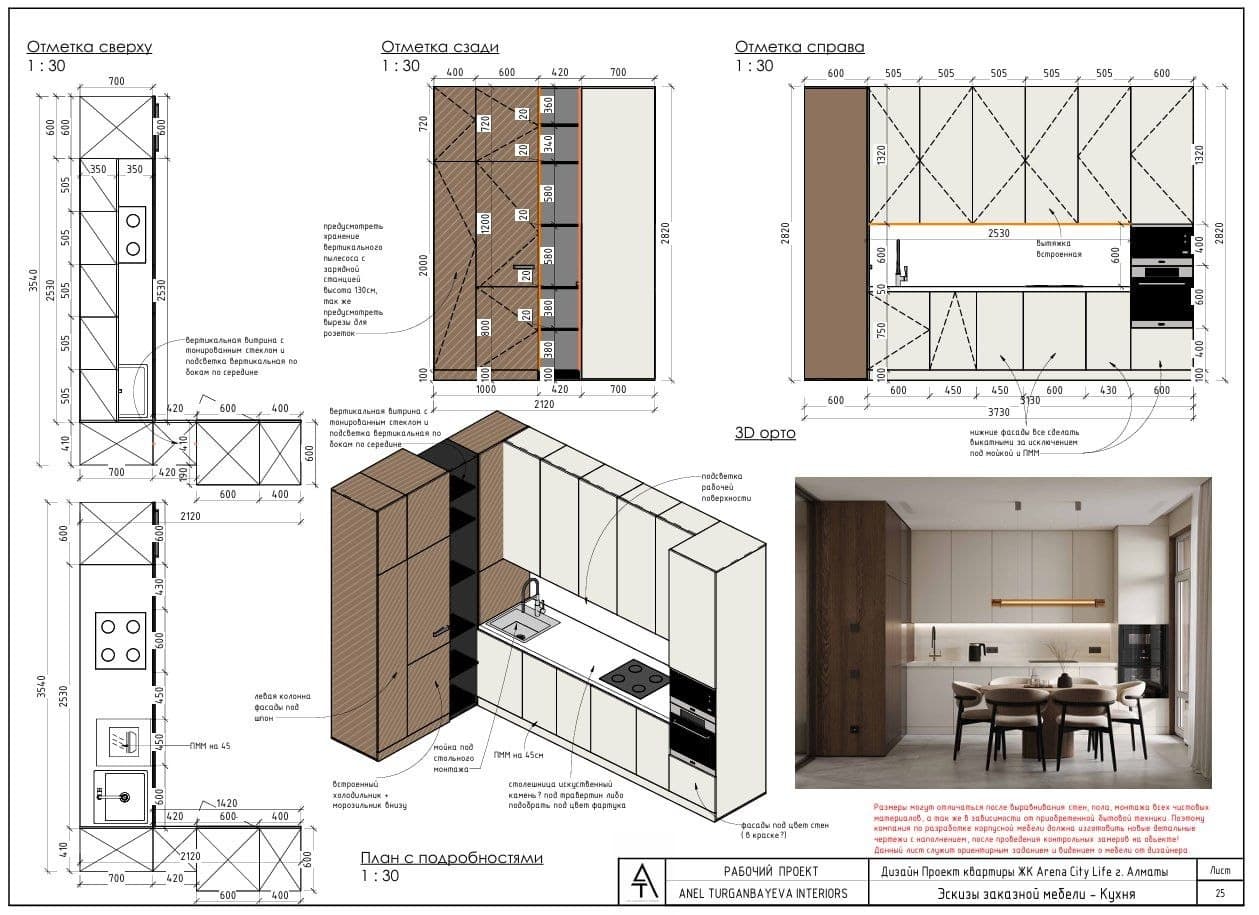
Kitchens, wardrobes and built-ins are made from drawings. It helps to send the same drawings to two or three workshops and compare prices, timing and materials: with an identical brief the comparison is fair. Precise furniture drawings save nerves: for example, the kitchen in Arena City Life was assembled from our drawings without a single redo.
Lighting, plumbing and furniture are often cheaper to order from China, but such orders have long delivery times and risks: defects are harder to return and specifications must be checked before payment. Place such orders as early as possible with time to spare.
Typical procurement mistakes
Buying without a project: materials are bought and then do not fit in size or style. Ordering a kitchen before plastering: dimensions taken on rough walls no longer match. Tiles from different batches. Buying "on sale" beyond the needed amount. Ordering long-lead items too late: installation frames, doors, furniture. Signing a delivery note without checking. And no single table: when orders are scattered across messengers, something will get lost.
What the studio does
Our design project includes online procurement: a shopping list of specific items for your interior. If you take design supervision (200,000 ₸ per month, usually 1–6 months), we help choose finishing materials, update the documentation when items are substituted and source lighting, furniture and plumbing from China. We visit the site at least once a week and report deviations from the project within 24 hours.
For example, we ran the 100 m² apartment on Seifullin with supervision and procurement: marble layouts were approved from elevations, and the result matched the renders. And we accompanied the family apartment in Europe City, Astana, from working drawings to placing the decor.
Summary
Procurement is not "a trip to the shop" but managing a hundred orders and deadlines. Start with a detailed shopping list, order long-lead items early, buy materials from one batch with allowance and check everything on delivery. If you want to handle this together with a designer, see the "Prices" section or message us on WhatsApp.