May 29, 2026
Contract with an Interior Designer: Nine Points to Check Before Signing
Design contracts are often signed unread: "it feels awkward to argue at the start of a relationship". That is a mistake. A detailed contract shows the studio understands its own process, and it is your insurance at the same time. Below are nine points we recommend checking in any contract with a designer, and the signals that should make you cautious.
An important caveat: these are practical tips from design practice, not legal advice. If the contract amount is large, the property is complex or the wording is unclear, show the contract to a lawyer before signing — it costs little compared with a dispute.
1. The parties and the subject of the contract
Check who the contractor is: a sole proprietor (IP) or a company (TOO), full details, BIN or IIN, address. A contract "with designer Asel" without details is almost useless if something goes wrong. On your side, the contract should name the person who will accept the work and pay.
The subject is what exactly is being done and for which property: address, measured area, type of space. "Development of a design project" is too vague. Better: "development of a design project for a 78 m² apartment at… with the scope set out in Annex 1". Area matters because price usually depends on it: in our studio, for instance, the fee is calculated per square metre, with a fixed price for spaces up to 40 m².
2. Scope of work — by stage and by sheet
This is the key point. Not "a design project" but a specific list: how many layout options, which rooms are rendered, which drawings are in the set, whether custom furniture drawings and a procurement list are included. The more detailed the list, the less chance of hearing "that was not included".
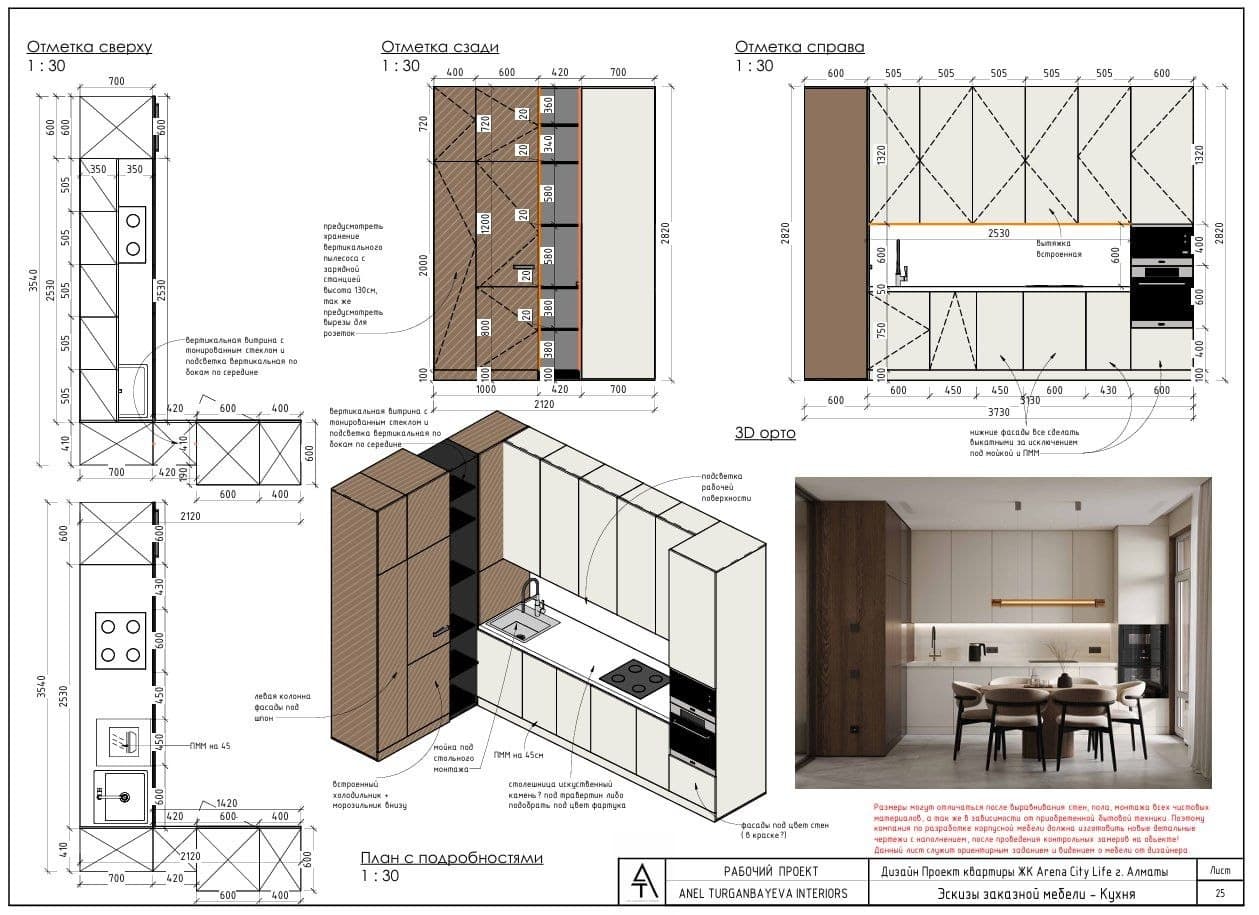
For reference: our working drawings package is 14 sheets (measured plan, demolition, construction, masonry plan, layout, door swings, floors and underfloor heating, ceilings and curtain tracks, plumbing, lighting with switching diagram, electrics, wall finish schedule, elevations, 3D views). The design project adds 3D renders, custom furniture drawings and online procurement. Compare what you are offered sheet by sheet.
Also clarify what is not included: construction works, purchasing materials, author supervision. Our studio, for example, only designs and does not carry out turnkey renovations — and it is worth seeing that spelled out in the contract so expectations match.
3. Stage timelines and approval time
A good contract sets a deadline for every stage, not a single date at the end. For example: measurement and brief — 1–3 days, layout — up to a week, concept and renders — 1–2 weeks, drawings — about a week. That way it is clear where the project stands and who is holding it up.
The contract must state that time for your approvals is not counted in the contractor's deadline. This is fair both ways: if you take a week to think over the layout, the project moves by a week, and that is not the studio's delay. It also helps to specify how many days you have to respond at each stage.
4. Revisions: how many and what kind
The contract should answer two questions: how many revision rounds are included at each stage, and what extra work costs. A specific number disciplines both sides: the client gathers comments into one list, and the contractor does not drag out making them.
Distinguish a revision from a change of brief. Changing a cabinet colour or moving the sofa is a revision. Switching from minimalism to neoclassical after the renders are done, or moving the kitchen after drawings are issued, is rework — and it is sensible for the contract to describe how that is priced.
5. Delivery and acceptance
How you receive the result (PDF files, a link, prints), who signs the acceptance certificate for each stage and how many days you have to review. A stage certificate confirms you are satisfied with the result and is the basis for the next payment.
Check what happens if you neither sign the certificate nor send comments on time. Many contracts treat the stage as accepted in that case. It is normal practice, but you should know about it in advance so you do not miss review deadlines.
6. Payment: by stage, not everything upfront
A convenient scheme is an advance for the first stage, then payment as each stage is delivered. 100% upfront for the whole project is a reason to ask questions: if the collaboration does not work out, getting money back will be harder. Check how the price is expressed (a fixed sum or a rate per m²), which area it is based on and whether it can change.
If author supervision is included, it is usually paid separately and monthly. Ours is 200,000 ₸ per month, typically for 1–6 months of renovation. It is good when the contract or an annex lists what a month of supervision includes: how many site visits, what reports, how quickly deviations are reported.
7. Rights to the project and publication
A design project is the result of creative work, and how it may be used is best stated explicitly. As a rule, the client receives the right to build the project at their property, while authorship stays with the designer. If you want to use the project elsewhere — repeat it in another apartment or hand it to a developer — agree on that separately.
Publishing in the studio's portfolio is common practice: it is how designers show their work to new clients. If privacy matters to you, discuss it and put it in writing: no address, no photos of the finished interior, or renders only. General copyright rules in Kazakhstan are set by the Law "On Copyright and Related Rights"; if rights are critical for you, agree on specific wording with a lawyer.
8. Liability for errors and what the designer does not control
Drawings can contain errors too: a wrong outlet height, a socket behind a wardrobe, a dimension that does not match the survey. It is good when the contract says how design errors are corrected — free of charge and within what time. Some contracts also specify who pays for rework on site if the error is genuinely in the design.
The reverse is also fair: the studio is not responsible for builders deviating from the drawings, or for the quality of materials and work of a crew it did not hire. That is exactly what author supervision is for: we visit the site at least once a week, keep photo and video records and report deviations within 24 hours, while they are still cheap to fix.
9. Termination and disputes
Sometimes a collaboration does not work out, and that is fine. The contract should give both sides a civilised exit: how many days' notice, how completed and started stages are paid for, what you receive. Usually, everything that has been done and paid for.
See how disputes are resolved: negotiation, a written claim procedure, court at the location of one of the parties. For complex cases and large sums this is precisely the section worth reading with a lawyer.
Annexes worth attaching to the contract
The scope of work by stage and sheet; the completed brief or technical assignment — your wishes, household, budget, style; the measured plan once it is ready; the schedule of stages and payments. When wishes are written down and signed, "that is not what we agreed" does not come up on either side.
If you have not written a brief yet, start with our project brief: it contains the questions we ask before starting. Its answers are easy to attach to the contract later.
Red flags
No written contract, "we will sort it out as we go"; the scope in a single line; a demand for 100% prepayment for the whole project; no stage deadlines; no stated number of revisions; the contractor refuses to put in writing what they promised verbally; nothing about what you receive on termination.
None of these on its own means bad faith, but each is a reason to ask a question before signing. A professional studio calmly explains its contract and makes reasonable clarifications.
Summary
Check nine points: parties and subject, scope, timelines, revisions, acceptance, payment, project rights, liability and termination. A detailed contract is not a sign of distrust but a way to agree on the essentials in advance. In complex cases, show the text to a lawyer.
Want to understand in advance what your project will include and what it will cost? See the Prices section and the cost calculator, fill in the brief or message us on WhatsApp — we will answer questions about scope and stages.