July 7, 2026
Art Deco in an Apartment Interior: Geometry, Brass and Deep Colours Without Theatrics
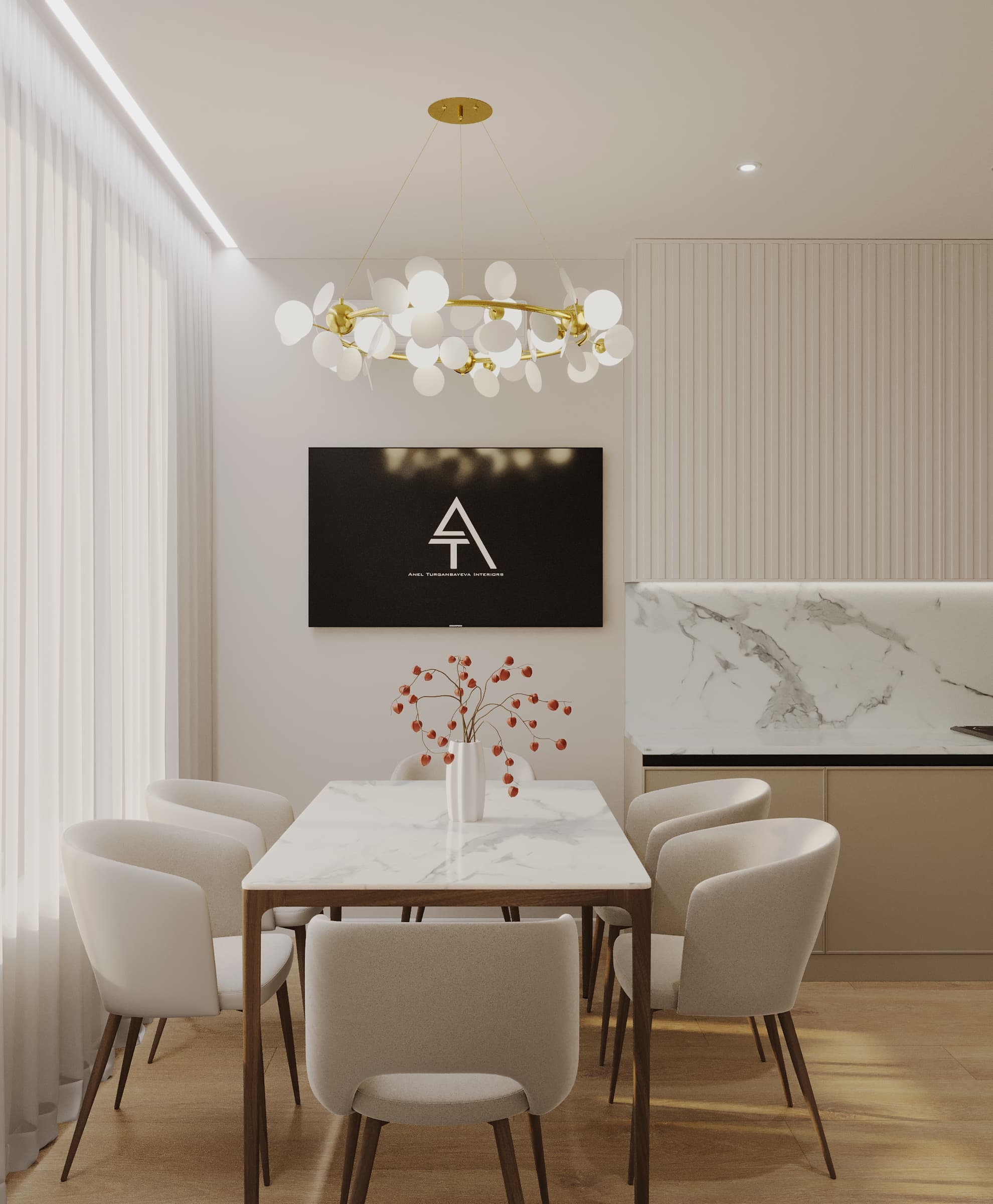
Art Deco was born as a manifesto of luxury: geometry, expensive materials, gloss and confidence in the future. A hundred years later it has returned to apartments, but in a different dose: not a film set of the 1920s, but individual notes of glamour on a calm modern base. The marble, fluted fronts and precise brass in our 100 m² apartment on Seifullin in Almaty are exactly that kind of light bow to Art Deco: the interior looks expensive because of its materials, not its decor.
In this article we explain how to recognise the style, which elements it is built from, how much of it a typical apartment in Almaty or Astana needs, and where people most often go wrong when they try to copy a picture from Pinterest.
Where the style came from
The name comes from the International Exhibition of Modern Decorative and Industrial Arts held in Paris in 1925. The style itself is older: the Théâtre des Champs-Élysées, opened in 1913, is often called one of the first Art Deco buildings in Paris. And nobody used the term Art Deco in the 1920s at all: it appeared in print in 1966 and became widely accepted after historian Bevis Hillier's 1968 book.
The heyday was the 1920s and 1930s. The symbol of the era is New York's Chrysler Building, completed in 1930, with its stepped spire and metal sunbursts. Echoes of the style exist in Soviet architecture too: Mayakovskaya station of the Moscow metro by architect Alexey Dushkin, opened in 1938, with columns clad in stainless steel and rhodonite, is often described as an example of Art Deco. That gives us the two main features of the style that still work today: machine-age geometry and a love of shining metal and stone.
The style dictionary: how to recognise Art Deco
Geometry. Sunbursts and fans, herringbone and chevron, diamonds, stepped silhouettes, semicircles and arches. These motifs appear in tile and parquet layouts, chair backs, headboards, mirror frames and wallpaper patterns. The key difference from neoclassicism: the ornament is not floral or antique but graphic, as if drawn with a compass and a ruler.
Materials. Brass and bronze (not chrome and not matte black), marble with a bold vein, lacquer and gloss, velvet, dark wood with a contrasting grain such as walnut or macassar, smoked and fluted glass, mirror. The combination of warm metal, stone and soft fabric creates the rich texture people choose this style for.
Palette. Deep saturated colours: navy, emerald, bottle green, burgundy, terracotta, sometimes black. They are balanced by cream, ivory, warm beige and the gold of the metal. Cold grey and pure white are foreign to the style: next to them brass loses its warmth.
Furniture and lighting. Furniture is rounded, with soft arcs and semicircular backs, on slender legs or a solid plinth. In Art Deco a light fixture is always jewellery: tiered chandeliers, half-moon and fan sconces, opal glass, brass rings and rods.
Art Deco, neoclassicism and Art Nouveau: telling them apart
These styles are often blended into one generic beautiful classic, and the interior loses its character. Neoclassicism relies on antiquity: symmetry, mouldings, pilasters, cornices and a calm light palette. Art Nouveau, the predecessor of Art Deco, loves flowing plant lines: stems, flowers, curves without corners. Art Deco takes symmetry and expensive materials from neoclassicism, but replaces floral ornament with geometry and pastels with deep colour.
A simple test: if you can draw rays or steps on an object with a ruler, it is Art Deco. If you want to trace it with the soft outline of a leaf, it is Art Nouveau. If you see an antique column or a classic moulding profile, it is neoclassicism. You can combine a neoclassical base with Art Deco accents in one apartment, but do it deliberately, not by accident.
How much Art Deco an apartment needs
Full immersion, with dark lacquered walls, marble floors, mirrored panels and a chandelier half the size of the ceiling, needs space, tall ceilings and a large budget. In a typical apartment with ceilings of about 2.7 to 3 metres such an interior quickly feels cramped and tiring. So we work in notes and keep a ratio of roughly 70 to 30: a calm neutral base and one third character.
The base is warm light walls, a simple floor and plain built-in furniture with smooth fronts. The character is two or three strong pieces per room: a fan-shaped or semicircular headboard, a mirror in a sunburst frame, a deep-coloured velvet armchair, brass handles and lamps, geometric tile on one surface. Repeat the metal and the colour in at least two or three spots in the room, otherwise the accent looks accidental.
Art Deco room by room
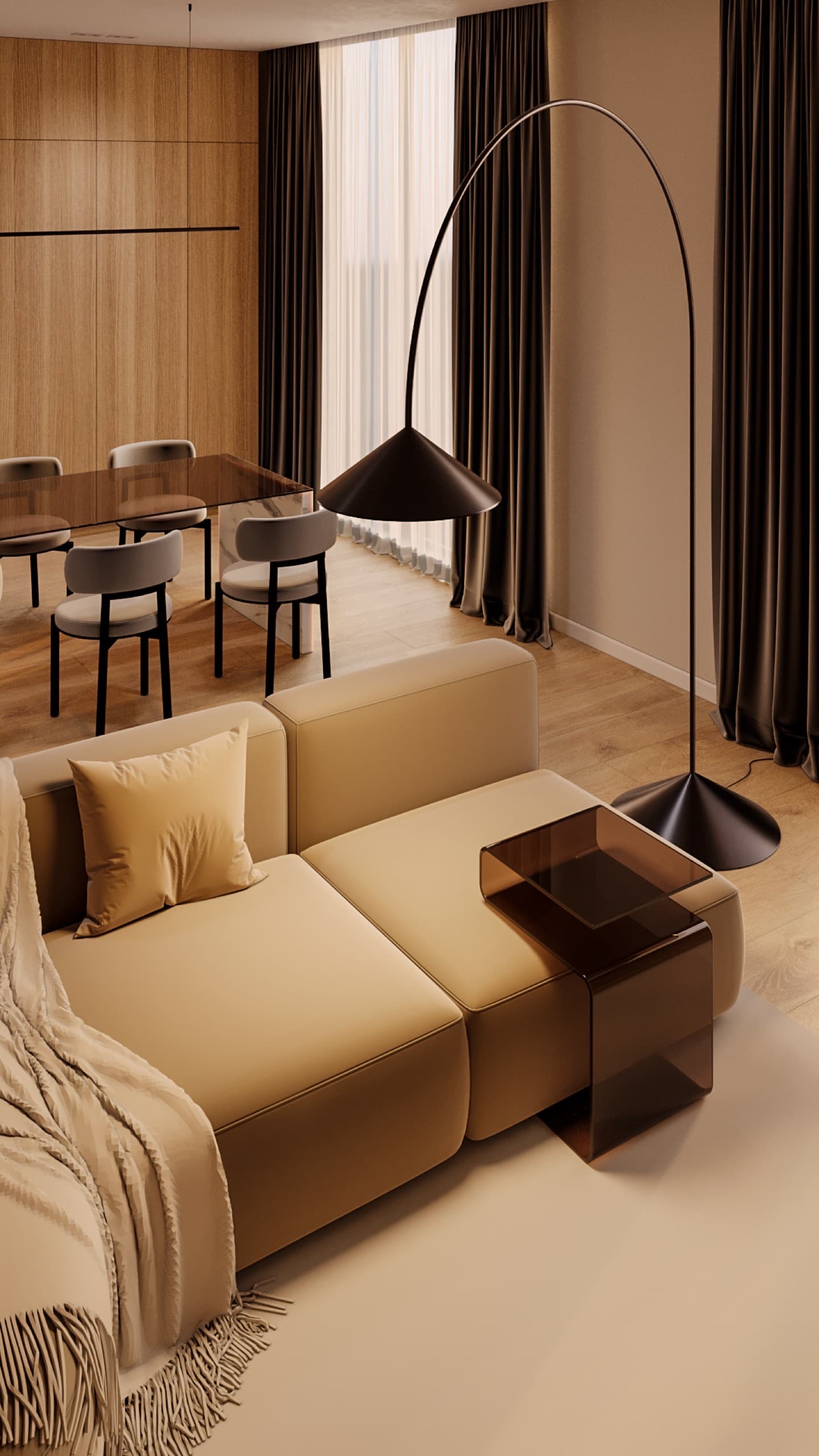
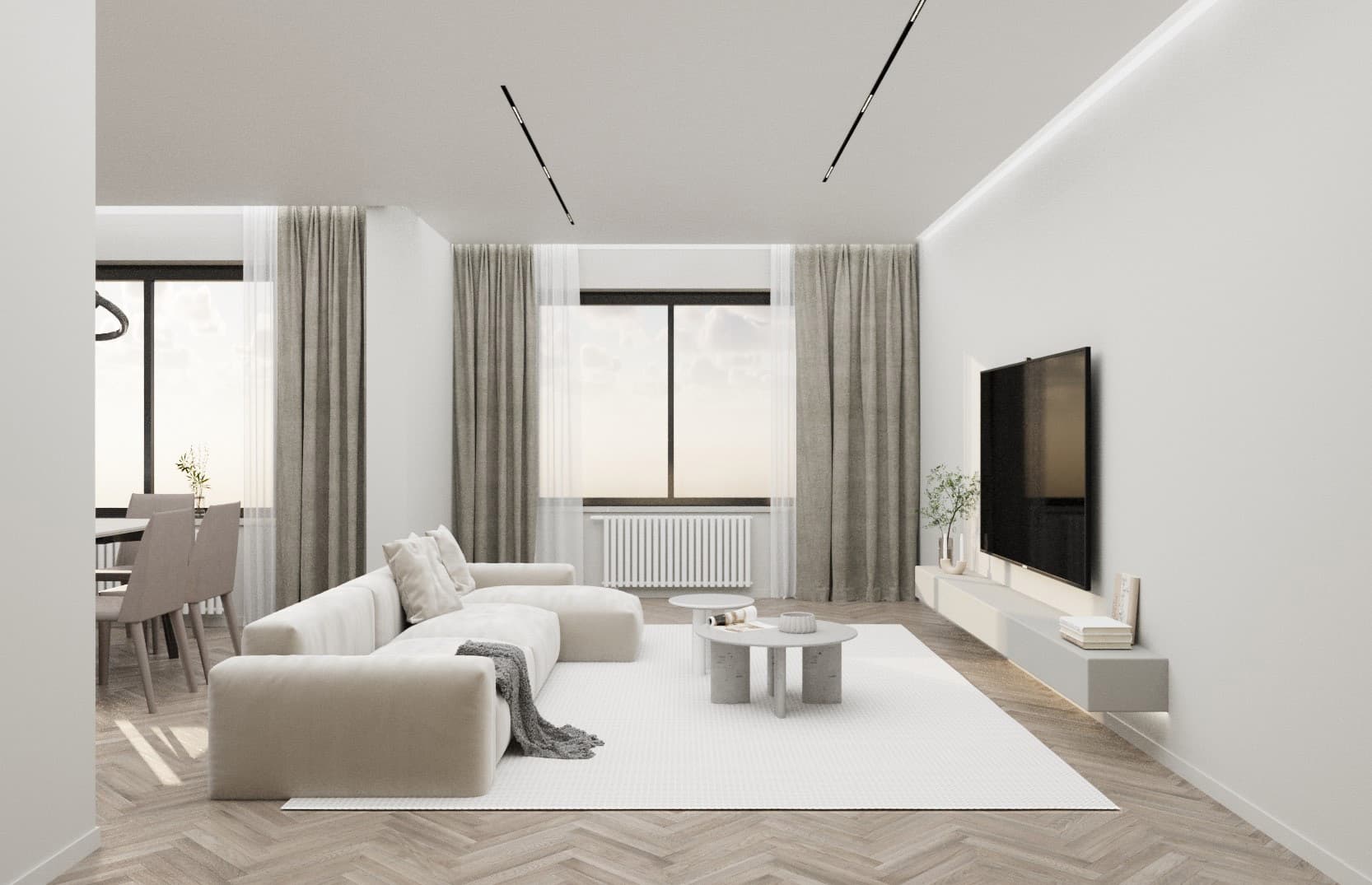
Living room. A sofa with a rounded back in velvet or bouclé, a coffee table with a marble or glass top on a brass base, a statement chandelier. One wall can get fluted panels or geometric wallpaper. A rug with diamonds or a stepped border ties the composition together.
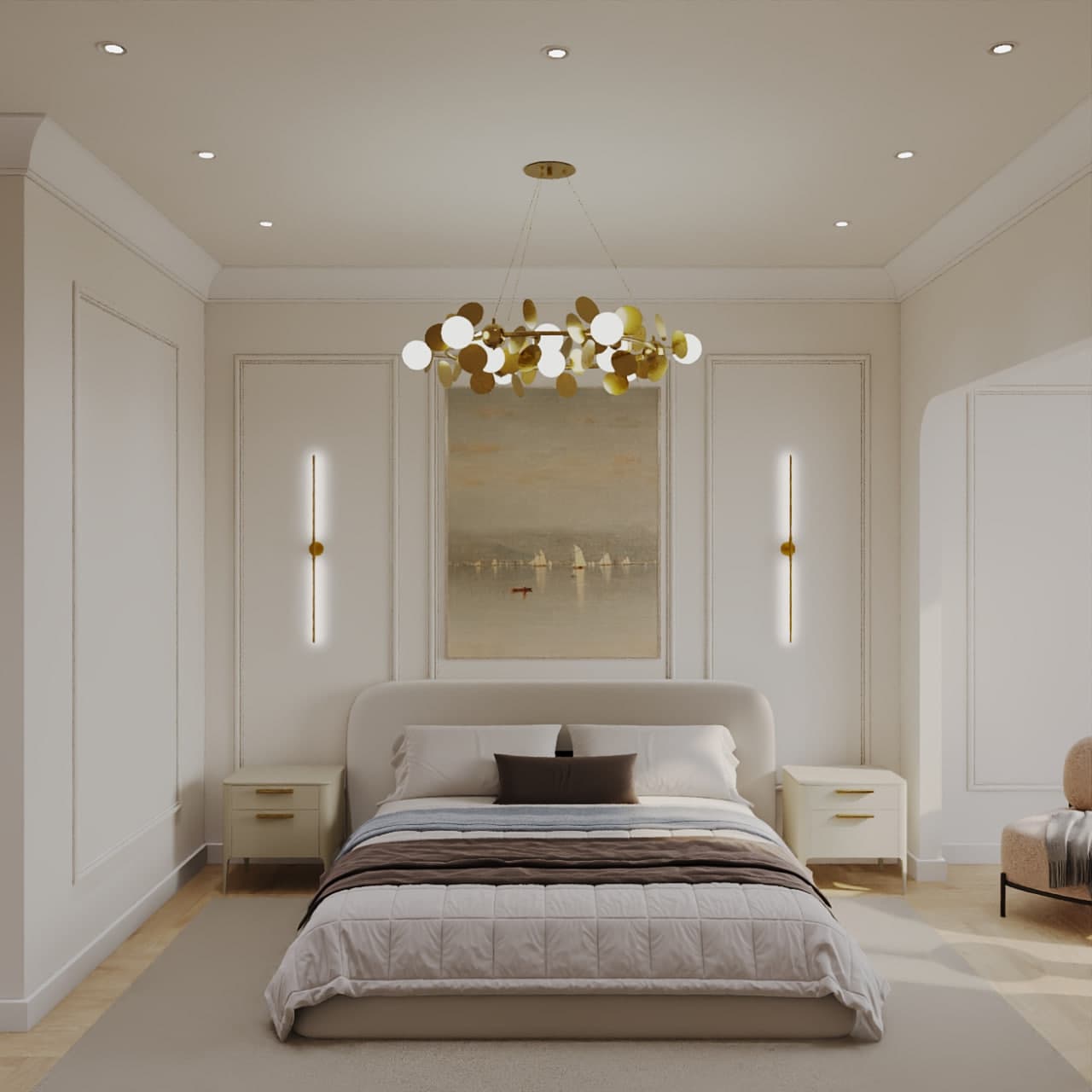
Bedroom. The best place for the style, because intimate drama belongs here. A tall upholstered headboard with vertical channel stitching or a fan shape, a dark wall behind the bed (navy, emerald, burgundy), bedside sconces with opal glass. Nightstands with rounded corners and brass handles finish the look.
Bathroom. Especially a guest bathroom: on a small area you can afford more courage. Herringbone or fan-pattern tile, dark stone or marble-look porcelain, a mirror in a brass frame, a tap in brass or bronze. Our bathroom concept for sanitaryware brands, with a deep green fluted column basin, shows how statement fixtures can become the main accent.
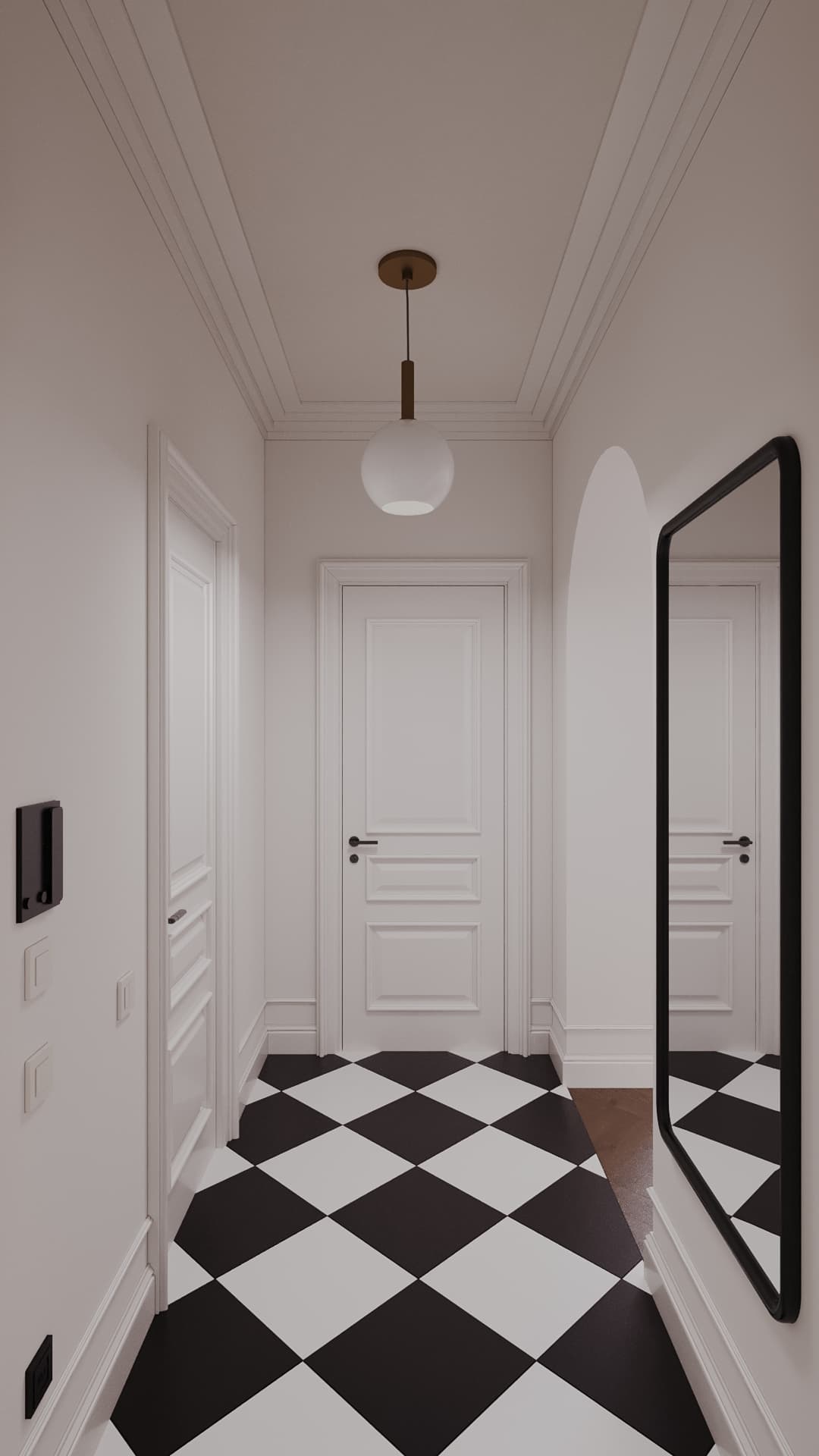
Hallway and kitchen. A chequered or geometric floor and a round mirror look good in a hallway. In the kitchen brass hardware, fluted glass in a display cabinet and stone on the backsplash are enough: the kitchen has to stay practical, so decor is kept to a minimum.
Materials: what to check before you buy
Brass can be lacquered or unlacquered. Unlacquered metal darkens and develops a patina over time, especially in a humid bathroom and on surfaces that are touched often. Some people love living aged brass, others do not, so decide in advance. For taps and hardware that need to look the same for years, people usually choose products with a durable brass-look finish from a reliable manufacturer.
Natural marble is beautiful but porous: it is etched by acids (lemon, wine, vinegar) and needs sealing. For a kitchen worktop or a bathroom floor, porcelain stoneware or engineered quartz with a marble pattern is often the smarter choice. Save natural stone for lower-wear places: a windowsill, a coffee table top, a feature panel in the living room.
Velvet and velour give depth of colour but collect dust and pet hair. In a home with animals and children, choose upholstery fabrics with high abrasion resistance and an easy-clean label, and check the rub test in the fabric specification. Gloss and lacquer are striking but show fingerprints and every flaw in the substrate, so walls for gloss paint need perfect preparation.
Common mistakes
Too much gold. When everything shines, handles, frames, legs, lamps and curtain rails, the interior turns into a banquet hall. One metal in one shade, repeated in several spots, is enough. Mixing brass with chrome and black metal in one room almost always looks messy.
Dark colour without light. Deep navy or emerald on every wall with a single ceiling light makes a room gloomy. Dark walls need layered lighting: general light, sconces, lighting in niches or shelves. Plan lighting scenes at the electrical stage.
Cheap imitation. Art Deco rests on the quality of materials. Glossy marble-effect film, plastic gold and fabric with an unpleasant sheen destroy the look faster than their absence. One real piece is better than five fakes.
Style without a base. If the walls are uneven and the layout is inconvenient, no brass sconce will save it. Layout, storage and lighting come first, the decorative layer comes after.
Checklist before shopping
Choose one main pair of colours (for example emerald and cream, or navy and warm beige) and one metal. Decide which rooms get an accent and which stay a calm base. Plan two or three characterful pieces per room. Make sure the geometric motif repeats at least twice: in tile and mirror, in headboard and rug. Plan several light sources in every room. Check that materials suit your lifestyle: children, pets, heavy cooking.
If you are not sure this is your style, take our What Is Your Style quiz and look at the Style Guide, where Art Deco is compared with neoclassicism, minimalism and mid-century.
Conclusion
Modern Art Deco is not a museum of the 1920s. It is the skill of adding geometry, warm metal, stone and deep colour to a calm interior in the right proportion. It works when beautiful objects are backed by a well-thought-out layout, lighting and quality materials.
If you want an interior with Art Deco character but without theatrics, fill in the project brief or message us on WhatsApp: we will discuss where accents belong in your apartment and what it may cost. You can estimate the project price with the calculator on the Prices page.