June 9, 2026
Renovating a Resale Apartment: What to Demolish, Keep, and Where Surprises Wait
A resale renovation differs from a new build in one word: the unknown. Under the wallpaper there may be solid plaster or crumbling sand; in the walls old wiring, sometimes aluminium, as in houses of past decades; under the linoleum either parquet worth restoring or several layers of hardboard. So the project starts with an inspection, and the budget with an honest reserve.
The upside of resale is different: ready infrastructure, a mature neighbourhood, often more floor area and higher ceilings for the same price. The downside is that the renovation is harder, longer and less predictable. This article is about making it manageable: what to check before buying, what to replace almost always and in what order to go.
What to check before buying
It is best to show the apartment to someone who will work in it: a designer or an experienced site manager. An hour of inspection can save millions. Ask for the floor plan from the property documents and compare it with reality: do the walls match, have partitions been removed, has a bathroom been merged. Unauthorised redevelopment complicates sales and mortgages, and in panel buildings removing load-bearing walls is also dangerous. In Kazakhstan redevelopment generally has to be approved; check details with the akimat, the public service centre or a lawyer.
Look for signs of trouble: leak marks on the ceiling and corners, mould, cracks, skewed doors, creaking or springy floors, cold external walls. Open all taps and check pressure and water colour. Switch on lights and test sockets across the apartment. Ask neighbours and the management company when the risers and the lift were last replaced. All of this gives you bargaining arguments and helps set an honest budget.
What to replace almost always
Electrics, completely, if the building is old: old wiring, twisted joints and two sockets per room are not meant for modern appliances. Wiring once designed for lighting, a TV and a fridge must now carry a hob, an oven, a washing machine and a dryer. Design the electrics before finishing: fixing mistakes afterwards costs noticeably more.
Water and drain pipes, from the riser or at least up to the first shut-off valves: patching old pipes is a flood postponed. According to expert assessments, in panel buildings of the 1960s–1980s it is the utilities that wear out fastest, while the structure itself lasts long. Windows and radiators depend on condition, but are replaced more often than not. Screed and plaster are checked by tapping: a hollow sound means the layer is detaching from the base.
Agree any work with risers and shared systems with the management company in advance: touching shared risers and ventilation ducts on your own is not allowed.
What is worth keeping
Parquet: sanding and oil or lacquer bring even worn oak back to life, while new solid wood is expensive. Plaster mouldings, tall doors, arched openings and original tile in older buildings are details a new build cannot offer at any price, and they work well in modern interiors.
Load-bearing walls and floor slabs are always kept. Almaty lies in a seismic zone, and experts directly name unauthorised redevelopment with removal of load-bearing walls as the main risk of old panel buildings. Check anything you plan to remove against the building design and agree it with a qualified specialist.
Typical surprises under the finish
The list we most often see when opening up: crooked walls with several centimetres of deviation, a screed that wanders in level, layers of old paint and wallpaper that prevent new plaster from sticking, pipes in walls without inspection hatches, someone else’s ventilation channels closed off, electrics hidden in unexpected places. Each item is an extra day or week and extra money.
That is why a resale estimate always has a line “opening up and inspection”. First we strip the finishes to the base and photograph everything we find, then adjust the project. This way you pay for real work, not guesses.
Order of works in resale
The order is the same as in our renovation stages guide, but with demolition and inspection at the start. Step 1: survey and layout plan. Step 2: demolition of finishes, old floors and unneeded partitions. Step 3: inspection of what is opened, project and estimate corrections. Step 4: rough works: partitions, screed, plaster, electrics and plumbing. Step 5: finishing and furniture installation.
After demolition, return to the designer: some decisions change based on what is found. That is why it pays when one person does both the project and the author’s supervision: they see changes immediately, not from someone’s photos. Our supervision is 200,000 ₸ a month with a site visit at least weekly and a report.
Resale budget and reserve
Guidelines for renovation with materials in Almaty and Astana for 2026: from about 150,000 ₸/m² economy, about 250,000 ₸/m² comfort, from about 450,000 ₸/m² premium; furniture and appliances separately. For resale it is worth adding a larger reserve than for a new build: even an experienced site manager cannot see some surprises until opening up.
For a new build we advise a 10% reserve; for resale it is sensible to set aside more, roughly 15–20%. This is our estimate, not a norm: the older the building and the more worn the utilities, the closer to the upper figure. You can calculate a budget for your area in the renovation budget calculator on the site.
Example: resale with character
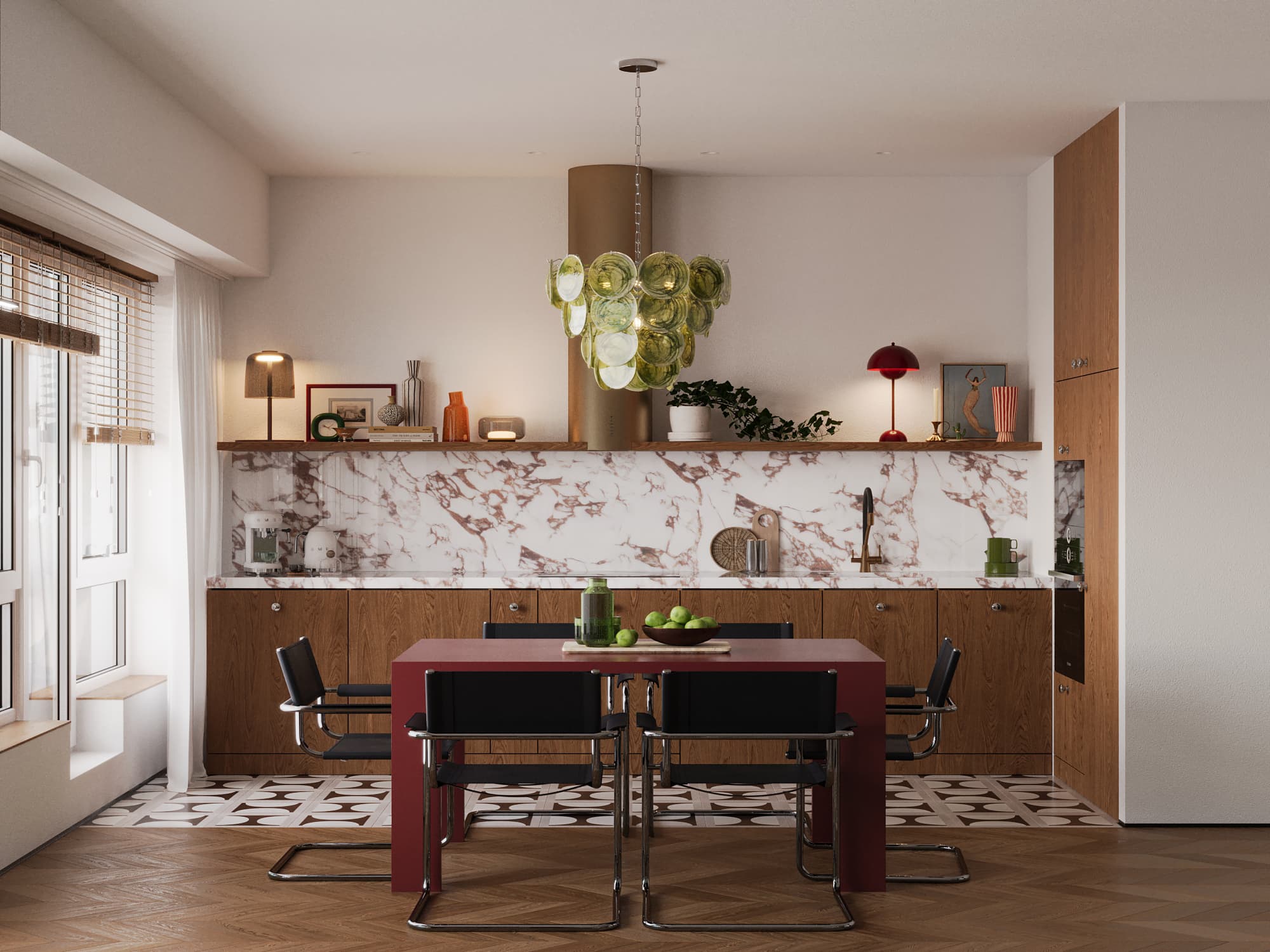
The 97 m² apartment in Taldykorgan that we worked on is an example of a mid-century interior. Such styles suit resale well: warm wood, simple lines and expressive furniture shapes help work with ceiling heights and the old geometry of rooms without trying to hide the character of the building.
The general principle: do not fight the apartment, use its features. Niches, bay windows, tall windows and thick walls become interior details if you notice them early on the plan.
In short: what to do
Show the apartment to a specialist before buying. Compare the floor plan with reality. Allow for inspection, replacement of electrics and pipes, and a larger reserve. Keep what gives character. Start with the project, not with knocking down walls.
If you are choosing or have just bought a resale apartment, send the plan on WhatsApp or fill in the project brief: we will suggest what is worth changing and what to keep.